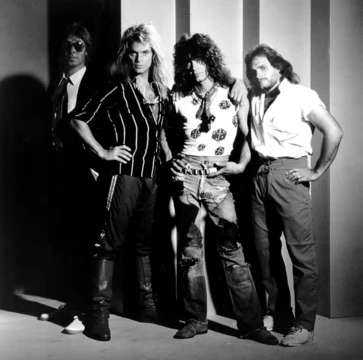
Tokyo, Japan
Where Eddie's six strings met a city that never stops burning bright.

In the sprawling touring universe of Van Halen, Tokyo, Japan stands as one of the most electric destinations on the band's global circuit. A city of neon density, relentless energy, and a rock-and-roll fan culture that treats live performance as a near-sacred event, Tokyo became a proving ground where Van Halen's wall-of-sound stagecraft and Eddie Van Halen's legendary guitar pyrotechnics met an audience that showed up with the same ferocious enthusiasm the band brought to the stage. Tokyo is not a single plot point but a recurring backdrop across the band's touring eras—a place where the Van Halen spectacle, with its massive light rigs, Eddie's constantly evolving Frankenstrat, and Alex Van Halen's drumming thunder, was translated for a culture that had built its own deep relationship with Western rock. For fans of the band's story, Tokyo represents the moment the American hard-rock machine crossed the Pacific and found a city ready to match its intensity.
- Location
- Tokyo, Japan
- Role
- Tour destination and major record market
- Band
- Van Halen
- Genre
- Hard rock / heavy metal
- Significance
- Key stop on international touring circuits across multiple eras
Lore & Background
Van Halen's relationship with the Japanese audience is woven into the broader tapestry of the band's identity as a touring act. Coming out of Pasadena, California, with a self-built stage show and a guitarist who treated his instrument like a living, shifting organism, the band carried an energy that translated powerfully into the packed halls of Tokyo. Japanese rock fans of the era were known for their organized, passionate support—fan clubs that mailed newsletters in crisp envelopes, meticulously collected import vinyl and tour programs, and a reverence for the live event that gave the Van Halen spectacle a particularly electric reception. The band's touring philosophy, which treated every city as a new canvas for the show, meant that Tokyo performances carried a particular weight. Eddie Van Halen's guitar work—characterized by his pioneering two-handed tapping technique, his habit of modifying his instrument mid-tour with fresh pickups or a coat of spray paint, and his showmanship that treated the guitar as both instrument and prop—found in Japanese audiences a crowd that rewarded technical virtuosity with the same fervor they gave to the band's more accessible, radio-friendly hits. The interplay between the band's heavier, more experimental material and their anthemic singles created a live dynamic that thrived in a city where the audience's energy fed back into the performers. In the broader narrative of the Van Halen universe, Tokyo represents the international dimension of a band that was, at its core, a California act. The city is where the band's story stopped being a regional phenomenon and became a global one, where the Frankenstein guitar and the wall of amplifiers stopped being a Pasadena curiosity and became a shared cultural experience across oceans.
In Their Own Story
The bass in the floor is so deep you feel it in your molars before you hear it. Outside, the Tokyo night hums with the white noise of a million engines and the blue glow of vending machines, but inside the hall, the air has turned to something thicker, charged. Eddie stands at the edge of the stage, his guitar half-disassembled, a cable dangling like a loose nerve, and the crowd roars not because he's playing but because he's there—because they know that any second, he'll snap the neck back into place, hit the first dive-bomb, and the room will detonate. Alex Van Halen's kick drum hits like a door slamming shut in a concrete hallway, and the Japanese fans—who have memorized every bootleg, every setlist variation, every flick of Eddie's wrist from grainy VHS tapes—answer with a unified scream that cuts through the amp hiss. This is not a concert; it's a convergence. For a few hours, the neon outside and the roar inside become the same thing, and Van Halen, a band born in a Pasadena garage, finds itself at home in a city that burns just as bright.
Reader's Guide
Tokyo, Japan, in the Van Halen touring universe, functions as the international apex of the band's live-performance story. It is the city where the Pasadena-born hard-rock machine crossed the Pacific and met an audience culture that amplified every element of the show—the technical guitar work, the theatrical stage presence, the sheer volume and light. Its role in the band's narrative is that of the proving ground: a destination where a band's global appeal is tested against one of the world's most demanding and enthusiastic live-music audiences. Tokyo is where the Van Halen spectacle stopped being a regional California phenomenon and became a shared, cross-cultural event. Why it matters to the fan: Tokyo represents the moment the story widens. It is the backdrop against which Eddie's guitar innovations, Alex's drumming, and the band's songwriting are received not as a local curiosity but as a full-scale musical statement. For anyone tracing the arc of Van Halen's career from garage band to global act, Tokyo is the city where that arc bends outward, where the story stops being about one band in one city and becomes about a sound that travels.
Did You Know?
- Van Halen's early stage name was 'Daddy's Garage,' a nod to the family garage in Pasadena where the brothers first played together.
- Eddie Van Halen's pioneering two-handed tapping technique, first showcased on the band's self-titled debut album, fundamentally changed what was considered possible on a six-string electric guitar.
- The band's 1984 album, which included the massive single 'Jump,' marked a significant shift toward a more polished, radio-friendly production style while retaining their hard-rock core.
- Eddie Van Halen was known for constantly modifying his guitar between tours, building and rebuilding his instrument—nicknamed the 'Frankenstrat'—so that each era of the band carried a visually and sonically distinct guit
More in World & Setting
Related in Van Halen
Links follow this subject's own source article.
Elsewhere in the Van Halen universe
Spotted an error? Know more?
This is a living reference — every entry is fact-audited, and reader corrections feed straight into our audit queue. Suggest an edit · See this site's audit record