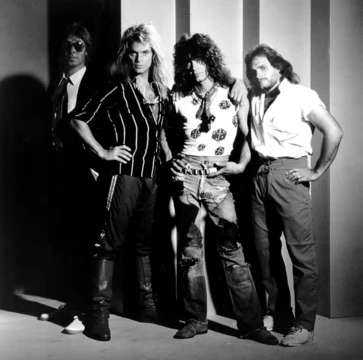
Van Halen
The debut that rewired rock guitar and sold ten million copies.

Van Halen is the debut studio album by American rock band Van Halen, released on February 10, 1978, by Warner Bros. Records. Widely regarded as one of the greatest debut albums in rock music, the album was a major commercial success, peaking at number 19 on the Billboard Top LPs & Tape chart. It has sold more than 10 million copies in the United States, receiving a Diamond certification from the Recording Industry Association of America (RIAA) and making it one of the best-selling albums in the country. The album contains some of the band's most well-known songs, including "Runnin' with the Devil", "Ain't Talkin' 'bout Love", "Jamie's Cryin'", their cover version of the Kinks' 1964 song "You Really Got Me", and the instrumental "Eruption"; written and performed by guitarist Eddie Van Halen, it is widely regarded as one of the greatest guitar solos of all time and helped popularize two-handed tapping.
- Debut album
- Van Halen (1978)
- Signature technique
- Two-handed tapping (Eddie Van Halen)
Verified Timeline
Lore & Background
The album's story begins with demos recorded in November 1976 at Village Recorders in Los Angeles, produced and financed by Gene Simmons of Kiss. The resulting three-track demo tape attracted little interest from record labels, and Kiss's manager Bill Aucoin even declined to manage the band. Guitarist Eddie Van Halen was not convinced of the quality of the material because they could not make the recordings with their own equipment. Simmons left to tour with Kiss after recording the demos, but said he would try to secure Van Halen a record deal afterwards. After those sessions, the band was offered several concerts. At a show at the Starwood in Hollywood, the group's future manager, Marshall Berle, discovered the band. He and musical entrepreneur Kim Fowley paired them with punk band Venus and the Razorblades for a gig at the Whisky a Go Go. After being well received by Berle at the Whisky a Go Go, the band gained the attention of Mo Ostin and Ted Templeman of Warner Bros., who both attended the band's performance at the Starwood on February 3, 1977. Van Halen proceeded to sign a contract with Warner. The recording of the debut album with producer Ted Templeman began August 29, 1977. The tracks were recorded quickly during sessions between August 31 and September 8, 1977. It was mostly recorded live, but "Runnin' with the Devil", "Jamie's Cryin'", "Feel Your Love Tonight" and "Ice Cream Man" contain guitar overdubs. Eddie also achieved the sitar-like sound for his solo on "Ain't Talkin' 'bout Love" using effects (a phase shifter and MXR flanger), not an actual electric sitar. Work on the album ended October 4 with the final mixing of "Little Dreamer" and "Eruption" (titled simply "Guitar Solo" on studio documents). Overall, the album cost approximately $54,000 to produce. "We didn't have a ton of material," recalled bassist Michael Anthony, "so we basically just took our live show and all the songs we knew and went for it. The whole album only took a couple of weeks. Ted Templeman wanted to make a big, powerful guitar record, and he had all he needed in what Eddie was doing."
In Their Own Story
The cover photos for Van Halen were taken at the Whisky a Go Go, capturing the band mid-set in a blur of sweat, hair, and stage lights. The iconic shot—David Lee Roth perched on a speaker, Eddie in a white jumpsuit—was snapped by photographer Neil Zlozower during a show on September 29, 1977. The band's name on the cover appears in a custom font designed by the band's friend and artist, Richard "Dick" Smith, who traced the letters from a magazine headline. The back cover features a group photo taken at the same gig, with Roth's hand resting on a fire extinguisher—a prop he'd grabbed to add some rock-star theater. The gatefold sleeve, a simple black-and-white affair, was chosen to keep costs down, but the inner sleeve included a lyric sheet that fans would pore over, memorizing every line.
Reader's Guide
If you're diving into Van Halen for the first time, start with the opening salvo: "Runnin' with the Devil" sets the tone with its slinky bassline and Roth's swagger, then let "Eruption" hit you like a sonic bomb—Eddie's two-handed tapping solo, recorded in one take on a homemade guitar, still sounds like it's from another planet. From there, "You Really Got Me" is the party anthem that made the Kinks' original sound like a polite request. For deep cuts, "Little Dreamer" shows the band's softer side, with Eddie's clean arpeggios and Roth's croon, while "On Fire" is a raw, punk-infused blast that captures their live energy. The album's sequencing is deliberate: side one ends with the stomp of "Ain't Talkin' 'bout Love," and side two kicks off with the cover of "You Really Got Me"—a one-two punch that never lets up. Listen on vinyl if you can; the warmth of the analog pressing makes Eddie's harmonics ring like church bells in a rock club.
Did You Know?
- The album cost approximately $54,000 to produce and was recorded mostly live between August 31 and September 8, 1977.
- Eddie Van Halen achieved the buzzing, exotic sound on his solo for "Ain't Talkin' 'bout Love" using a phase shifter and MXR flanger, not an actual electric sitar.
Frequently Asked Questions
What is Van Halen?
Van Halen is a legendary American hard rock band that formed in 1972 in Pasadena, California, built around the inseparable brother pair of Eddie Van Halen on guitar and Alex Van Halen on drums, with Michael Anthony handling bass and lead vocals. Their self-titled 1978 debut album shattered expectations and put the name on the map for an entire generation of rock players.
What is Van Halen's signature technique?
Eddie Van Halen's two-handed tapping let a single guitarist produce rapid, interlocking note sequences that sounded almost like a full band, turning the electric guitar into a percussive, near-orchestral force in live performance. This approach redefined what was considered possible on a six-string and inspired countless players who still chase that sound today.
When and where was Van Halen formed?
The band came together in 1972 in Pasadena, California, growing out of the local garage-and-club scene. Eddie and Alex Van Halen, along with bassist-vocalist Michael Anthony, forged the group's identity on that small Southern California circuit before breaking onto the national stage.
How does Van Halen's story end?
Eddie Van Halen died in October 2020 following a battle with throat cancer, bringing a definitive close to the era defined by his guitar work. Alex Van Halen has since carried the band's name forward in new configurations, but the original brother-driven lineup is no longer intact.
Why is Van Halen important to rock history?
They demonstrated that technical showmanship and sheer stage energy could dominate mainstream hard rock, earning a 2010 Rock and Roll Hall of Fame induction. More than four decades later, their influence still echoes in how guitarists approach speed, tone, and live performance.
More in Factions & Groups
Elsewhere in the Van Halen universe
Spotted an error? Know more?
This is a living reference — every entry is fact-audited, and reader corrections feed straight into our audit queue. Suggest an edit · See this site's audit record