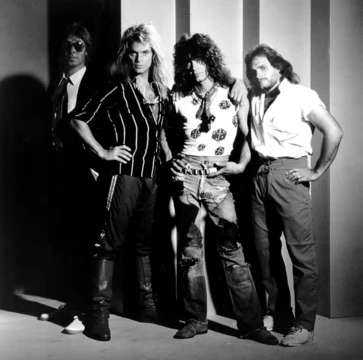
The L.A. Metal Scene
Big hair, louder amps, and a whole city that refused to sit down.

The L.A. Metal Scene refers to the vibrant, high-octane Southern California hard-rock and heavy-metal ecosystem that flourished from the late 1970s through the 1980s, with Van Halen as one of its most consequential forces. Born in the Pasadena suburbs and amplified on the Sunset Strip, this scene blended technical guitar virtuosity, theatrical stagecraft, and an irrepressible party ethos into a cultural movement that reshaped rock music worldwide. Van Halen did not simply participate in this scene—they helped define its sonic and visual grammar. Eddie Van Halen's two-handed tapping, the band's relentless stage energy, and their refusal to take themselves too seriously set a template that dozens of Southern California bands followed, from Mötley Crüe to Guns N' Roses to Ratt. The scene was as much a social world—club nights, backstage hangouts, a shared aesthetic of big hair and loud amps—as it was a musical one.
- Geographic heart
- Pasadena / Sunset Strip, Los Angeles, California
- Peak era
- Late 1970s – mid 1980s
- Van Halen's role
- Sonic and stylistic pioneers of the scene
- Signature innovation
- Two-handed tapping technique (Eddie Van Halen)
- Cultural signature
- Theatrical stagecraft, high-energy live shows, irreverent humor
- Associated acts
- Mötley Crüe, Guns N' Roses, Ratt, W.A.S.P., Dokken
Lore & Background
The scene crystallized in the smoggy, sun-bleached corridors of Southern California in the late '70s. Van Halen, two brothers from Pasadena and a vocalist with a microphone and a grin, turned the Whisky a Go Go and the Roxy into temples of speed and spectacle. Their debut record, released in 1978, introduced a guitar sound that made existing rock players rethink their technique almost overnight. The tapping licks, the wah-wah riffs, the sheer physicality of the live show—this was a new vocabulary, and the local scene absorbed it quickly. By the early '80s, the Sunset Strip had become a kind of open-air rehearsal space for an entire generation of bands. The aesthetic coalesced: teased hair, leather, sequins, a wink to the audience mid-solo. Van Halen sat at the apex of this pyramid, not as kings but as the guys who'd cracked the code first. They toured relentlessly, their stage shows a blur of pyrotechnics, audience interaction, and Eddie's famously improvised guitar work. The scene's social glue was as important as its music—backstage parties, shared roadies, a sense of sibling rivalry that kept every band sharpening its act. As the decade wore on, the scene's commercial peak and its internal tensions became inseparable. The party image that had been a genuine expression of joy was increasingly flattened into a marketing formula. Van Halen, by the mid-'80s, had already begun pushing past the scene's boundaries—incorporating synth textures, exploring different vocal pairings—while the younger wave of bands doubled down on the hair-and-chrome template. The L.A. Metal Scene, as a unified cultural moment, began to fragment, but its fingerprints remained on every shred guitar, every arena production, and every rock band that ever told the audience to 'put your hands up.'
In Their Own Story
The bass thump hit before the lights did. You could feel it through the soles of your boots in the back of the Starwood, that subsonic pulse that meant the next band was about to tear the roof off. The air was thick—cigarette smoke, cheap beer, the metallic tang of a hundred sweating bodies pressed together. Someone in front of you had a poster of Eddie Van Halen taped to their amp case, the paper already curling from the humidity. A girl in shredded denim and a leather jacket passed a flask; the whiskey burned but didn't touch the anticipation. Then the house lights died, and the crowd surged forward like a single animal. A single white spotlight hit the stage, and for a split second, there was silence—just the hum of amps and the rattle of a snare drum being tested. Then the first chord hit, and the room exploded into a chaos of flying hair, raised fists, and the kind of joy that only comes from knowing you're in the exact right place at the exact right time.
Reader's Guide
The L.A. Metal Scene is the cultural and musical ecosystem of Southern California hard rock and heavy metal, spanning roughly 1977 to the mid-1980s. It is not a single organization but a constellation of bands, venues, producers, and fans orbiting the Sunset Strip and its satellite clubs. Its central goal—unspoken but universal—was volume, speed, and spectacle. Every band in the scene was competing to be the loudest, fastest, and most visually arresting act in the room. Van Halen occupied a unique position: they were the scene's architects, not just its tenants. Eddie Van Halen's tapping technique, the band's live-show philosophy, and their blend of technical precision with self-deprecating humor became the baseline that every subsequent L.A. band measured itself against. The scene's membership was fluid. Van Halen, Mötley Crüe, Guns N' Roses, Ratt, W.A.S.P., Dokken, and dozens of other acts all drew from the same well of influence and shared the same venues. Rivalry was fierce but the community was tight; roadies, sound engineers, and managers circulated between bands. The "conflict" was less ideological than competitive: who could fill the arena, who could write the hook, who could make the audience lose their minds. In the broader narrative of rock music, the L.A. Metal Scene represents a specific moment when technical innovation, theatrical performance, and a distinctly Californian sense of fun collided to produce a sound that dominated global rock radio for a decade. Van Halen's place in that story is foundational—they lit the fuse.
Did You Know?
- Eddie Van Halen's two-handed tapping technique, first heard on the band's 1978 debut album, was so novel that many guitarists initially believed the recordings used a second guitarist playing in unison.
- Van Halen's early live shows on the Sunset Strip were known for their improvisational chaos—Eddie would often extend solos into unscripted, extended passages that varied from night to night, making no two shows identical
- The band's famous 'Frankenstrat'—a guitar built by Eddie from a pile of mismatched parts—became an iconic symbol of the scene's do-it-yourself, anti-establishment ethos, standing in contrast to the polished, corporate ro
- Van Halen's 1984 album and its accompanying tour are widely cited as the moment the L.A. Metal Scene transitioned from a local club circuit phenomenon into a global commercial force, opening the door for the wave of '80s
More in Factions & Groups
Elsewhere in the Van Halen universe
Spotted an error? Know more?
This is a living reference — every entry is fact-audited, and reader corrections feed straight into our audit queue. Suggest an edit · See this site's audit record