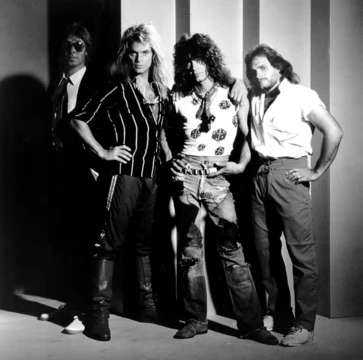
The Van Halen Fan Community
A million hands on a million guitars, all chasing the ghost of one impossible riff.

The Van Halen Fan Community is the sprawling, multi-generational collective of listeners, guitarists, collectors, and devotees who have built an entire subculture around the music of Eddie, Alex, and Michael Anthony (and later, Sammy Hagar, Anthony, and David Lee Roth). Born from the Pasadena club scene of the mid-1970s, this community grew from a small circle of LA rock enthusiasts into a global network of headbangers, shredders, and memorabilia hunters who treat the band's catalog as a living, breathing mythology. Within the broader Van Halen universe, the fan community functions as the audience that validates the music, the culture that keeps Eddie's guitar techniques alive in countless bedroom studios, and the emotional engine that carried the band through lineup changes, commercial peaks, and the devastating loss of Eddie in 2020. They are, in essence, the reason the story continues to be told.
- Roots
- Pasadena, California club scene, mid-1970s
- Catalyst event
- The legendary demo 'Tape' that secured the band's first record deal
- Hall of Fame induction
- 2010, Rock and Roll Hall of Fame
- Cultural signature
- Guitar-obsessed headbanging, tapping-technique emulation, Frankenstein-guitar iconography
- Generational span
- Active across 1970s, 1980s, 1990s, 2000s, and 2020s audiences
- Status
- Ongoing; community reorganized around remembrance and legacy after Eddie Van Halen's passing in 2020
Lore & Background
The fan community's mythology is inseparable from Eddie Van Halen's guitar. Long before tapping was a recognized technique, before 'Eruption' became shorthand for guitar virtuosity, a kid in Pasadena was wiring pickups by hand, building a Frankenstein of a guitar, and playing with a ferocity that made local club owners both thrilled and terrified. The fans who witnessed those early shows in the LA underground became the first evangelists, spreading word of a band that sounded like nothing else in rock. That early word-of-mouth network—passing around cassette tapes, trading mixtapes, arguing about whether the bridge in 'Ain't Talkin' 'bout Love' was the greatest four bars ever written—laid the groundwork for what would become one of rock's most devoted followings. By the 1980s, the community had crystallized into something with its own visual language: the flame-and-bolt guitar as a totem, the cartoon 'Eddie' character on album sleeves as a mascot, the headbanging mosh pit as a ritual. Guitarists worldwide began transcribing Eddie's licks, building their own Frankenstein guitars, and treating the Van Halen catalog as a technical curriculum. The fan community was no longer just listeners; it was a school, a family, a shared identity built around the idea that a guitar could be an extension of the human nervous system. Eddie's passing in 2020 transformed the community's relationship with the band's legacy. What had been a living, evolving culture of anticipation—waiting for the next album, the next tour, the next Eddie guitar trick—shifted into something more reflective. Fans became archivists, storytellers, and guardians of a musical heritage they felt was in danger of being diluted by nostalgia. The community's role evolved from cheering the band forward to preserving the emotional truth of what the music meant to each individual who first heard it.
In Their Own Story
The basement smelled like solder flux and old beer. Marcus, nineteen, had his first Ibanez propped against the wall, its neck still slightly warped from the heat of the garage outside. On the laptop, the opening bars of 'Eruption' were looping for the fourteenth time. His fingers ached from trying to match the impossible speed of that two-handed tap, but he didn't stop. He couldn't. Somewhere in the static of that loop, he was hunting for the same ghost that had driven a kid in Pasadena to wire pickups by hand decades before. Outside, the sun was setting, but Marcus didn't notice. He was lost in the sound of a riff that had been passed down like a secret—from tape to CD to YouTube, from one bedroom to another, from one generation of fans to the next. And when he finally nailed that first cascade of notes, he didn't cheer. He just sat back, smiled, and hit play again. Because that's what this community does: it keeps the impossible alive, one loop at a time.
Reader's Guide
The Van Halen Fan Community is not a single organization but a diffuse, self-organizing culture of individuals united by devotion to the band's music, its guitar legacy, and its broader rock identity. Its 'goals' are informal: to keep the music alive, to pass Eddie's techniques to the next generation of players, to preserve the emotional memory of live shows, and to honor the band's members—particularly Eddie—through continued engagement with the catalog. Members range from the original 1970s LA club-goers who saw Van Halen before they were famous, to 1980s headbangers who owned every vinyl pressing, to 2010s YouTube-era kids who discovered 'Jump' in a commercial and never looked back. The community's internal 'conflict' is generational: older fans guard the authenticity of the early catalog, while newer listeners arrive through the pop-crossover hits and slowly discover the depth underneath. In the broader narrative of rock history, this community functions as the living audience that gives the music its ongoing meaning. Without the fans transcribing licks, building guitars, filling arenas, and telling each other stories about that one show in '83, the Van Halen story would be just a discography. The community is the story's engine.
Did You Know?
- Eddie Van Halen's early 'Frankenstein' guitar was built from salvaged parts and hand-wired pickups, and its chaotic, asymmetrical appearance became one of rock's most recognizable visual icons—fans still build replicas t
- The band's first record deal was secured largely through a homemade demo tape that Eddie and Alex sent to a record label, and that tape's story became a foundational myth passed down through the fan community for generat
- Eddie's two-handed tapping technique, showcased prominently in 'Eruption,' was so novel in the mid-1970s that it effectively created a new category of guitar performance, and the fan community's obsession with transcribi
- The cartoon 'Eddie' character that appeared on Van Halen album artwork became an unofficial mascot for the fan community, appearing on t-shirts, stickers, and fan art long before the band had a formal merchandise operati
More in Factions & Groups
Elsewhere in the Van Halen universe
Spotted an error? Know more?
This is a living reference — every entry is fact-audited, and reader corrections feed straight into our audit queue. Suggest an edit · See this site's audit record