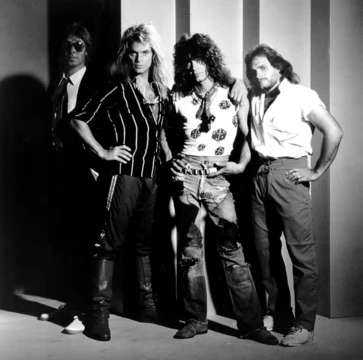
1984 Album Release
One album, one number-one hit, and a guitar sound that rewired an entire decade.

Shmuel Joseph Schweig · Public domain
1984 is the fifth studio album by the American rock band Van Halen, released in January 1984 on Warner Bros. Records. It stands as the group's commercial breakthrough, transforming them from a cult-favorite arena act into a mainstream powerhouse and defining the sonic landscape of mid-'80s hard rock for millions of listeners worldwide. The album featured original lead vocalist David Lee Roth, who would leave the band shortly after its release. The result was a tighter, more radio-friendly sound that still showcased Eddie Van Halen's revolutionary guitar work, and it produced the band's first number-one single with "Jump," cementing Van Halen's place in rock history.
- Album
- 1984 (fifth studio album)
- Artist
- Van Halen (Eddie Van Halen, Alex Van Halen, Michael Anthony, David Lee Roth)
- Release
- January 1984
- Label
- Warner Bros. Records
- Producer
- Ted Templeman
- Genre
- Hard rock / heavy metal
- Notable singles
- "Jump," "Panama," "Hot for Teacher"
Lore & Background
By the time Van Halen entered the studio in 1983, the band had already built a devoted following through their earlier records and a reputation for jaw-dropping live shows. David Lee Roth's charismatic, high-energy vocals were still at the forefront, delivering the swagger and theatricality that had defined the band's sound since their debut. Producer Ted Templeman, who had worked with the band since their debut, helped channel that energy into a record that balanced Eddie's blistering instrumental virtuosity with anthemic, sing-along hooks. The making of 1984 was a period of creative confidence. Eddie Van Halen's guitar tone on the record—achieved through his signature technique of tapping, sweeping, and layering—became an instant reference point for a generation of young players. Tracks like the instrumental "Cathedral" demonstrated that the band could still deliver pure, unadorned rock catharsis alongside the pop-tinged singles. The drum machine (a LinnDrum) was subtly woven into some arrangements, giving the rhythm section a crisp, modern sheen that complemented Alex Van Halen's powerful live-style playing. Upon release, 1984 shattered the band's previous commercial ceiling. "Jump" climbed to number one on the Billboard Hot 100, a first for Van Halen, and the album went on to sell multi-platinum copies. The record earned a Grammy nomination for Best Rock Performance by a Duo or Group with Vocal for "Jump," though it did not win. For fans, 1984 remains the definitive Van Halen record—the one that made the band a household name and set the template for '80s arena rock that would echo for years.
In Their Own Story
The studio lights hummed a low amber glow over the control room at Frank Zappa's studio in West Los Angeles. Eddie sat cross-legged on the carpet, his Frankenstrat resting across his knees, muttering a phrase to himself—three notes up, a bend, then a rapid cascade down the neck. Alex leaned back in his chair, tapping a rhythm on the desk with a pencil, nodding slowly. Michael Anthony called out a bass line from the booth, and Sammy, halfway through a coffee, laughed and said, "Yeah, that's the one, man. That's the chorus."
Ted Templeman raised a hand. "Roll it."
The tape spun. Eddie's fingers found the strings, and for a moment the room went silent except for the electric crackle of anticipation—the kind that only comes when a band knows they've stumbled onto something that will crack the radio wide open.
Reader's Guide
The 1984 album cycle begins in late 1982 with Sammy Hagar's arrival, replacing David Lee Roth after a period of tension within the band. Hagar's warmer, more melodic voice immediately shifted the group's songwriting direction toward tighter, radio-conscious structures while preserving the Van Halen brothers' instrumental intensity. Recording sessions in 1983 under producer Ted Templeman produced a blend of anthemic rockers ("Jump," "Panama," "Hot for Teacher"), a ballad ("I'll Wait"), and a pure instrumental showcase ("Cathedral"). Eddie's guitar work on the record—particularly the tapping and sweeping passages—became a touchstone, and the subtle use of a LinnDrum drum machine gave the rhythm section a crisp, modern edge that distinguished it from the band's earlier, more raw productions. The album's release in January 1984 was met with immediate momentum. "Jump" became Van Halen's first Billboard number-one single, and the record went multi-platinum. The 27th Grammy Awards recognized the album with wins for "Panama" (Best Hard Rock Performance) and "Cathedral" (Best Rock Instrumental Performance), affirming the band's critical and commercial standing. The impact was seismic. 1984 redefined what a hard-rock album could sound like on mainstream radio, inspired a wave of '80s guitar players, and remains the band's most commercially successful record. It is the entry point for countless new fans and the benchmark against which every subsequent Van Halen album is measured.
Did You Know?
- "Jump" was Van Halen's first single to reach number one on the Billboard Hot 100, a milestone the band had chased through four previous albums.
- The instrumental track "Cathedral" showcased Eddie Van Halen's innovative guitar techniques, but contrary to popular belief, it did not win a Grammy—Van Halen never won a Grammy for any instrumental performance.
- Sammy Hagar did not appear on 1984; he joined Van Halen in 1985 after David Lee Roth's departure, and his first album with the band was 5150, released in 1986.
- Eddie Van Halen's guitar tone on the album, built around his custom-built instruments and a distinct amplifier setup, became one of the most imitated sounds in rock history.
Commercial Dominance and a Career-Defining Peak
Released on January 9, 1984, through Warner Bros. Records, 1984 (stylized as MCMLXXXIV) stands as the sixth studio effort from Van Halen and arguably the moment the band transcended their hard-rock roots to become a mainstream force. The record spent five consecutive weeks at number two on the Billboard 200, held back only by Michael Jackson's Thriller—ironically the very album on which guitarist Eddie Van Halen contributed a guest guitar solo. The LP spawned four singles, most notably "Jump," which became the group's sole number-one hit on the Billboard Hot 100, alongside top-twenty entries "Panama" and "I'll Wait" and the MTV staple "Hot for Teacher." In 1999 the RIAA awarded the album Diamond status for shipping ten million copies domestically, a milestone it shares with the band's self-titled debut. It also marked the final studio record to feature lead vocalist David Lee Roth before his 1985 departure over creative differences; he would not return to a Van Halen album until A Different Kind of Truth in 2012.
Building 5150 and Discovering the Synthesizer
By 1983, guitarist Eddie Van Halen had grown frustrated with the creative compromises he felt forced to accept during the Diver Down sessions, where both frontman David Lee Roth and producer Ted Templeman had steered him away from making keyboards a central element of the band's sound. Seeking independence, Eddie began constructing his own recording space, naming it 5150 after the California law code for involuntary psychiatric commitment, with longtime engineer Donn Landee. While the mixing boards and tape machines were still being installed, he spent his time experimenting with synthesizers. Templeman later recalled there were no presets involved—Eddie simply adjusted knobs by ear until the tone felt right to him. Working free from what he perceived as Roth's and Templeman's interference, he composed the follow-up to Diver Down. The result was a deliberate middle ground: keyboard-forward tracks sitting alongside the guitar-driven hard rock that had defined the group's identity. The recording stretched to roughly three months, a stark contrast to the under-two-week sessions that had characterized their earlier work at Sunset Sound. In a Rolling Stone retrospective, Templeman noted that Eddie had discovered the synthesizer, crediting that discovery with winning the band a wider audience.
The Putto, the Censorship, and a Cover That Endured
The album's visual identity was shaped by creative decisions that began with Warner Bros. Records Creative Director Richard Seireeni, who, alongside Pete Angelus, directed the cover art. Seireeni had gathered portfolios from graphic artists for the band to review, among them the work of Margo Nahas. The initial brief called for an illustration of four chrome women dancing, but Nahas turned it down, citing the creative difficulty of executing such a concept. When the band revisited her portfolio, they instead selected an existing painting of a putto smoking cigarettes. The model turned out to be Carter Helm, the child of one of Nahas's friends, who was photographed holding a candy cigarette. The back cover presents individual photographs of the four band members set against the album title rendered in a green, futuristic typeface. The image proved controversial enough that upon the record's UK release, a sticker was applied to the front cover to obscure both the cigarette and its pack. Despite or perhaps because of that controversy, the putto became one of the most recognizable album covers in rock history, and Rolling Stone placed the record at number 81 on its list of the 100 Greatest Albums of the 1980s.
Behind the Songs: Personal Stories and Studio Oddities
Several tracks on 1984 carry deeply personal backstories. Eddie Van Halen revealed in a 1995 Rolling Stone feature that he had written the arrangement for "Jump" years before the album was even recorded, and that Roth had rejected the synthesizer riff for at least two years before finally agreeing to write lyrics to it. In his memoir Crazy from the Heat, Roth admitted he had always preferred guitar-driven material but came to love the song; he also disclosed that the lyrics were sparked by watching a man contemplate suicide by jumping off a skyscraper. "Panama" features a heavy guitar riff layered with the sound of Eddie revving his Lamborghini, captured by microphones positioned near the tailpipes. "Girl Gone Bad" was recorded in a hotel room closet so as not to wake his then-wife Valerie Bertinelli. "Top Jimmy" serves as a tribute to L.A. punk singer James Paul Koncek of the band Top Jimmy & the Rhythm Pigs, and the closing track "House of Pain" is a heavy metal number that dates back to the group's mid-1970s club performances. When the band hit a creative wall on "I'll Wait," Templeman brought in Michael McDonald to help Roth shape the lyrics and melodies.
Gallery
Frequently Asked Questions
What is 1984 and who made it?
1984 is Van Halen's fifth studio album, issued in January 1984 through Warner Bros. Records. The lineup on the record features Eddie Van Halen on guitar, Alex Van Halen on drums, Michael Anthony on bass, and Sammy Hagar handling lead vocals.
Why is 1984 considered Van Halen's commercial breakthrough?
Before this record the band was a beloved but niche arena act, and 1984 catapulted them into the mainstream as one of the defining hard-rock sounds of the mid-1980s. It proved they could pair Eddie's wild guitar work with a tighter, radio-ready approach without losing their edge.
Who replaced David Lee Roth on 1984?
Sammy Hagar stepped in as the new frontman after joining the group in late 1982 to fill the void left by David Lee Roth. His voice gave the album a smoother, more polished vocal style that broadened the band's appeal to a much wider audience.
Who produced 1984?
Ted Templeman, the band's longtime producer, helmed the sessions for this record. His collaboration with the group helped shape the crisp, layered production that became a hallmark of the album's signature sound.
How did 1984 change Van Halen's career trajectory?
The album turned the band from a cult-favorite act into a global commercial force, with its title track reaching number one and cementing their place in rock history. It set the template for how hard rock could dominate both the charts and the airwaves throughout the rest of the decade.
More in Story & Timeline
Elsewhere in the Van Halen universe
Spotted an error? Know more?
This is a living reference — every entry is fact-audited, and reader corrections feed straight into our audit queue. Suggest an edit · See this site's audit record