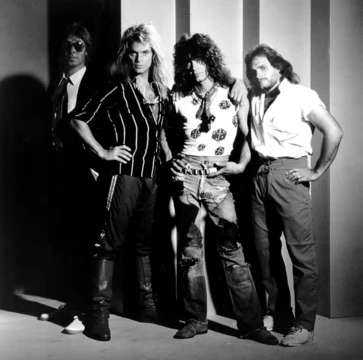
Sammy Hagar Era Begins (1986)
The red beard takes the mic and Van Halen becomes something raw, new, and fiercely debated.

The Sammy Hagar Era (1986) marks the seismic creative turning point in Van Halen's history: the moment the band's iconic frontman David Lee Roth stepped away and the red-bearded rocker Sammy Hagar—long a fixture of the Southern California hard-rock scene—stepped into the spotlight. For fans, this transition redefined the band's sonic identity, shifting the balance from Roth's theatrical showmanship toward a grittier, more blues-tinged vocal delivery that leaned heavily into Eddie Van Halen's guitar work. This entry covers the immediate aftermath of Roth's 1985 departure, Hagar's recruitment, and the recording and release of the landmark album *5150* in 1986. It is the chapter where Van Halen stopped being a one-man show and became, in the eyes of many, a true band—though the split in fan allegiance it created has never fully healed.
- New vocalist
- Sammy Hagar (formerly of Montrose)
- Outgoing vocalist
- David Lee Roth (departed 1985)
- Debut album of era
- 5150 (1986)
- Guitarist
- Eddie Van Halen
- Bassist
- Michael Anthony
- Drummer
- Alex Van Halen
- Hagar's nickname
- The Red Rocker
Lore & Background
By the time David Lee Roth announced his departure in 1985, the internal tensions between his larger-than-life persona and the band's creative direction had become impossible to ignore. Eddie Van Halen, who had long chafed under the spotlight-sharing arrangement, saw the opening as a chance to shape the music more directly. The search for a replacement was brief: Sammy Hagar, whose Montrose records and relentless touring had made him a fixture of the West Coast rock circuit, was a natural fit both musically and personally. Eddie and Sammy shared a love of classic rock, a workmanlike studio ethic, and a mutual respect that would blossom into a decades-long friendship. The recording of *5150* was, by all accounts, a collaborative high-water mark. Eddie's guitar took center stage in a way it rarely had under Roth's arrangement, and Hagar's voice—gritty, soulful, unapologetically blues-rooted—gave the songs a weight and a swagger that felt different from the band's earlier, more playful catalog. The album's title, drawn from a California mental-health code section, was a tongue-in-cheek nod to the chaos of the recording process and the band's own self-deprecating humor. For the fan community, 1986 became a watershed. Long-time Roth devotees felt the band's playful, theatrical energy had been replaced by something harder and more conventional. Conversely, listeners who found the earlier Van Halen a bit too novelty-driven discovered in Hagar's voice a raw, emotionally direct quality that resonated deeply. The split in allegiance—Roth fans versus Hagar fans—became one of the most enduring tribal divisions in rock fandom, and the 1986 transition remains the fault line along which it cracked.
In Their Own Story
The studio in Hollywood hummed at two in the morning, the kind of hour when the air smells like cold coffee and hot amp tubes. Eddie sat cross-legged on the carpet, a Fender Stratocaster half-disassembled in his lap, muttering to himself about a pickup winding. Sammy leaned back in a leather chair, red beard catching the amber glow of the studio lights, a half-empty glass of something amber in his hand. He wasn't singing. He wasn't performing. He was just *listening*—eyes half-closed, head nodding to a rough mix of a track that sounded like a freight train rolling through a blues bar. The song was 'Good Enough,' and it had taken twelve takes to get the riff to snarl just right. Eddie finally snapped the pickguard back into place, looked up, and said, 'You hear that space between the verse and the chorus? That's where you live now.' Sammy didn't answer. He just took a slow sip, grinned, and let the silence hang—because he already knew.
Reader's Guide
The arc of the 1986 transition unfolds in three broad beats. First, the departure: David Lee Roth's 1985 exit leaves the band in a creative vacuum, and the fanbase fractures almost immediately between those who see it as liberation and those who see it as a betrayal of the band's identity. Second, the recruitment and recording: Sammy Hagar, already a well-known West Coast rocker, is brought in with minimal fanfare. The studio sessions for *5150* are described by those present as unusually collaborative, with Eddie's guitar ideas driving the compositions and Hagar shaping melodies around them rather than the other way around. Michael Anthony and Alex Van Halen anchor the rhythm section, and the result is a record that feels, to many ears, like the most 'band-like' Van Halen album to date. Third, the release and reception: *5150* arrives in 1986 to strong commercial performance and critical attention, but the fan reaction is sharply divided. The album establishes the template for the Hagar era—bluesier, heavier, more emotionally direct—and sets the stage for the follow-up records that will define the late '80s and early '90s. The impact is twofold: it proves the band can thrive without Roth, and it cements a generational divide in the fanbase that persists to this day. For Eddie, it is also the beginning of a personal friendship with Hagar that will outlast the band itself.
Did You Know?
- Sammy Hagar had already been a major solo and band artist (Montrose) before joining Van Halen, so the 'new singer' was far from a newcomer to the rock world.
- The album title '5150' references a section of the California Welfare and Institutions Code dealing with involuntary psychiatric holds—a self-deprecating joke about the chaos of the recording sessions.
- Eddie Van Halen and Sammy Hagar's friendship, forged during the 5150 sessions, lasted decades and extended well beyond the band, including post-Van Halen collaborations.
- The Hagar era's sonic shift—more blues-inflected, less novelty-driven—sparked a fanbase split that remains one of the most passionate and long-running divisions in classic-rock fandom.
More in Story & Timeline
Elsewhere in the Van Halen universe
Spotted an error? Know more?
This is a living reference — every entry is fact-audited, and reader corrections feed straight into our audit queue. Suggest an edit · See this site's audit record