Tapping
Two hands become one instrument, and the fretboard becomes an endless highway of sound.

Gage Skidmore from Surprise, AZ, United States of America · CC BY-SA 2.0
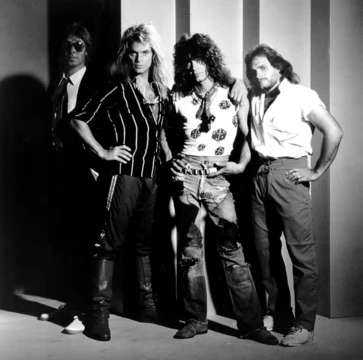
Tapping is the signature guitar technique most closely associated with Eddie Van Halen and the band Van Halen. In the fan-lore of the Van Halen universe, it is treated less as a mere playing style and more as a kind of sonic power—a way of making the instrument speak in rapid, cascading phrases that seem to exceed the physical limits of two hands. Where traditional rock guitar relied on picking, strumming, and single-hand hammer-ons, tapping unlocked a new register of speed, fluidity, and melodic density. The technique's arrival in 1978, showcased most memorably in the instrumental opener 'Eruption' on the band's self-titled debut, reshaped what audiences expected a rock guitarist to be capable of. It became the defining 'artifact' of the Van Halen sound and a technique that generations of players have since attempted to replicate.
- Practitioner
- Eddie Van Halen
- First prominent showcase
- "Eruption," Van Halen (1978 debut album)
- Technique type
- Two-handed tapping (fretting-hand hammer-on / pull-off)
- Instrument
- Electric guitar
- Band
- Van Halen
- Genre impact
- Pioneered modern rock/shred guitar vocabulary
Lore & Background
In the mythology of the Van Halen world, tapping is not simply a fingering pattern; it is the moment the guitar stopped being a plucked string and became a voice. Eddie Van Halen, working in a garage in Pasadena in the late 1970s, discovered that if the fretting hand could strike the string directly onto the fret—hammering it in rather than letting a pick drag it into vibration—the notes could arrive faster, cleaner, and with a legato smoothness that picking could never match. The result was a cascade of sixteenth and thirty-second notes that sounded almost like a keyboard, yet carried the growl and sustain of a guitar. 'Eruption,' the three-minute instrumental that opened the 1978 debut, became the canonical demonstration. Listeners heard a wall of interlocking tapped phrases, ascending and descending the neck in a single unbroken breath, and the rock world's understanding of what a lead guitarist could do was permanently recalibrated. The technique was not invented in a vacuum—classical guitarists had used similar fingerings for centuries—but Eddie's application to a heavily distorted electric guitar, combined with his aggressive tone and theatrical stage presence, made it a cultural event. Within the fan community, tapping is often spoken of with the reverence usually reserved for a superpower. It is the 'artifact' that separates Van Halen's guitar work from the rest of the 1970s rock landscape. Players who master it are said to have 'touched the Frankenstein current,' and the technique remains the first thing aspiring shredders attempt when they pick up a guitar for the first time, chasing the ghost of that garage in Pasadena.
In Their Own Story
The garage smelled of solder and stale coffee. Eddie sat cross-legged on the concrete floor, the Frankenstein guitar across his knees, its mismatched pickups glowing under a single bare bulb. He wasn't playing a song. He was talking to the neck. His fretting fingers drummed the strings in rapid, percussive bursts—tap, tap, tap, tap—each note landing like a small hammer strike, clean and bright. Then the picking hand joined, and the two hands began a conversation, trading phrases, overlapping, spiraling upward. The amp, cranked past reason, roared back. For eleven minutes he played, and the walls vibrated, and somewhere down the street a neighbor turned their radio up just to hear what that sound was. When he finally stopped, the strings were still humming, and the air in the garage felt thinner, as if the notes had been subtracted from the room.
Reader's Guide
Tapping is a guitar technique in which the fretting hand strikes the string directly onto a fret, producing a note without the intervention of a pick. In the Van Halen canon, it is the defining sonic signature of Eddie Van Halen's playing. In practice, the player presses a string down on a lower fret with one finger, then uses another finger of the same hand to 'hammer' the string onto a higher fret. The reverse motion—pulling the string off the fret with the fretting hand while the picking hand or another fretting finger sustains the note—completes the cycle. When both hands are active simultaneously, the result is called two-handed tapping, and it is the form most associated with Van Halen. The effect is a legato, keyboard-like flow of notes that can move up and down the neck at extraordinary speed, far beyond what single-hand picking can achieve. It works best on an electric guitar with a sustain-rich tone, a low action, and a solid amplifier driving the signal into gentle overdrive. Within the band's recordings, tapping appears most prominently in instrumental passages and lead solos. Eddie used it as both a melodic tool and a textural one, weaving tapped phrases into riffs and building entire solos from cascaded tapped runs. It became the technique that defined the 'shred' era of rock guitar and remains the first advanced skill most aspiring players attempt after basic barre chords.
Did You Know?
- The tapping technique has roots in classical and flamenco guitar fingerstyle, but Eddie Van Halen's application to a heavily amplified electric guitar in a rock context is what made it a cultural phenomenon.
- 'Eruption,' the 1978 instrumental that became tapping's most famous showcase, contains no vocal parts and no traditional verse-chorus structure—it is purely a guitar statement.
- Eddie Van Halen's early guitar, the so-called 'Frankenstrat,' was a one-off instrument he built himself, and it was on that guitar that much of the early tapping vocabulary was developed.
- The technique's visual spectacle—both hands dancing across the fretboard—became a central element of Van Halen's live shows, turning the guitar solo into a kind of athletic performance.
Roots in Amsterdam and the Pasadena Years
Eddie Van Halen entered the world in Amsterdam on January 26, 1955, into a family shaped by music and cultural displacement. His father Jan was a Dutch jazz musician who played piano, clarinet, and saxophone for the Dutch Air Force and local ensembles, while his mother Eugenia was a Euro-Indonesian woman originally from Java. The couple faced mistreatment in 1950s Netherlands because of their mixed-race relationship, prompting a 1962 relocation to Pasadena, California, where Jan supplemented his music income by working as a janitor and Eugenia worked as a maid. The boys, who did not speak English natively, endured bullying at school as "minority" students. Their musical education began at age six with piano lessons under Stasys Kalvaitis in San Pedro. Between 1964 and 1967, Eddie claimed first place in the Long Beach City College annual piano competition. Though his parents hoped for classical careers, the brothers were drawn to rock, inspired by British Invasion acts like the Beatles and the Dave Clark Five. Eddie never learned to read sheet music; instead he absorbed Bach and Mozart recitals by ear and improvised freely.
The Tapping Revolution and Guitar Pinnacle
Eddie Van Halen's most enduring contribution to guitar playing was his popularization of the tapping technique, a method that let a guitarist use both hands on the fretboard to produce rapid, cascading arpeggios that previously seemed impossible. This innovation redefined what audiences expected from electric guitar performance and cemented his reputation as one of the most influential players in rock history. His improvisational approach, rooted in ear-based learning rather than formal notation, gave his playing a spontaneous, almost reckless quality he himself attributed to the influence of Jimmy Page, while acknowledging Eric Clapton as his primary inspiration. As a teenager he would practice for hours with his bedroom door locked or walk around the house with his guitar strapped on. The industry recognized his stature: Guitar World Magazine's "100 Greatest Guitarists of All Time" poll placed him at number one, and Rolling Stone's 2023 list of the "250 Greatest Guitarists of All Time" ranked him fourth. These accolades reflected a career in which technical daring and raw expressiveness coexisted, making him a benchmark for generations of aspiring guitarists.
From Mammoth to Mainstream Megastardom
The band that would become Van Halen started in 1972 as Mammoth, a duo of brothers Alex and Eddie in the Los Angeles scene. When David Lee Roth joined as vocalist two years later, the group adopted the Van Halen name and became a fixture at clubs like the Whisky a Go Go. A pivotal moment came in 1976 at The Starwood, where Kiss bassist Gene Simmons attended a show opening for UFO. Struck by what he heard, Simmons urged the band to abandon a yogurt-company investment deal and invited them to cut demos at Electric Lady Studios in New York, including an early version of "Runnin' with the Devil." However, when Kiss management pushed back, Simmons tore up the contract and let them go. Warner Records stepped in the following year with a recording deal. Their 1978 self-titled debut climbed to No. 19 on the Billboard pop chart and was celebrated as one of rock's most successful debuts. By the early 1980s the band was among the era's top acts, and 1984 went five-times Platinum within a year of release. The origin of its lead single "Jump" traced back to Eddie's fascination with Kiss's "Creatures of the Night" and his subsequent interest in keyboards.
Final Years and Passing
After a career that spanned nearly five decades and reshaped the sound of rock guitar, Eddie Van Halen's later years were marked by a series of health challenges that began in the 1990s and progressively affected his ability to perform and record. Despite the physical toll, he remained a figure of immense respect within the music world, as evidenced by his 2015 appearance at the Smithsonian's National Museum of American History, where he reflected on his family's journey from Amsterdam with "approximately $50 and a piano" to the heights of American rock stardom. On October 6, 2020, at the age of 65, Van Halen suffered a stroke and was taken to Saint John's Health Center in Santa Monica, California, where he died. His passing closed a chapter in rock history that had opened with two immigrant brothers in Pasadena, one of them a teenager with a guitar and a door locked behind him.
Gallery


Frequently Asked Questions
Who is the originator of tapping in Van Halen lore?
Eddie Van Halen is universally credited with bringing two-handed tapping into the mainstream rock consciousness. While fragments of the technique appeared in earlier jazz and classical settings, he was the first to make it the defining voice of hard-rock guitar.
What exactly is tapping as a Van Halen power?
In the band's fan mythology, tapping is treated as a sonic artifact that lets one player produce cascading, near-impossible runs by driving both hands across the fretboard at once. Mechanically it pairs the picking hand's strikes with the fretting hand's hammer-ons and pull-offs, effectively doubling the number of available attack points on the strings.
Where did Van Halen first showcase tapping to the world?
The 1978 debut album opened with the instrumental 'Eruption,' a two-and-a-half-minute display that became the technique's defining public moment. That single track instantly separated the band from every other rock act of the era and set the template for what an electric guitar could sound like.
How does tapping differ from standard picking or strumming?
Traditional rock guitar assigns each hand a fixed role—one plucks, the other stops strings—while tapping merges them into a single coordinated engine. The result is a legato density and speed of notes that feels almost beyond the physical reach of two hands on one neck.
Why is tapping considered a turning point for rock guitar?
It expanded the melodic and rhythmic vocabulary available to electric-guitar players, opening a register of fluidity and speed that prior techniques simply couldn't reach. Virtually every shred and progressive-metal guitarist who came after built their language on the foundation Eddie laid with that two-handed approach.
More in Powers & Artifacts
Elsewhere in the Van Halen universe
Spotted an error? Know more?
This is a living reference — every entry is fact-audited, and reader corrections feed straight into our audit queue. Suggest an edit · See this site's audit record