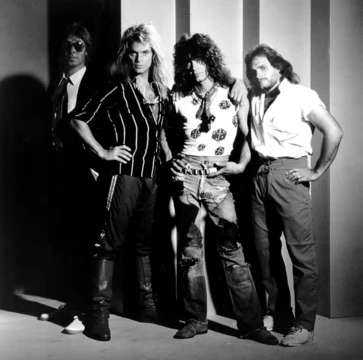
Warner Bros. Signing (1977)
Four guys from a Pasadena garage walk into a Warner Bros. office. They walk out with a future. The room never knew what hit it.

The Warner Bros. signing of 1977 is the pivot point where Van Halen stopped being a fiercely beloved Southern California club act—a band that could make the floorboards sweat at the Starwood on a Tuesday—and became a nationally recorded band. After years of grinding through the LA and Pasadena venue circuit, building a cult following one blistering show at a time, the four-piece finally landed a major-label contract that would trap their explosive live energy onto vinyl for the first time. This entry covers the context, the people involved, and the immediate aftermath of that deal, which produced the self-titled debut album released in early 1978. For fans, it’s the 'before' snapshot: the band at the exact threshold between underground legend and the rock superstars they would become within a few short years.
- Band members at signing
- Eddie Van Halen (guitar), Alex Van Halen (drums), Michael Anthony (bass/vocals), David Lee Roth (lead vocals)
Lore & Background
By 1977, Van Halen had been a fixture of the Southern California club scene for roughly five years. The Van Halen brothers—Eddie on guitar and Alex on drums—had built a reputation that was almost entirely word-of-mouth: guitar players who heard Eddie's two-handed tapping and whammy-bar tricks would seek out the next show, and the audience would grow from room to room. Michael Anthony on bass and backing vocals, and David Lee Roth on lead, rounded out the lineup that would eventually be captured on tape for a major label. The band was known for high-energy, technically dazzling live sets that left local musicians and audiences genuinely stunned, and that reputation was the currency that eventually got a record executive's attention. The signing itself was, by all widely reported accounts, a relatively straightforward A&R decision: a label representative heard the band (or heard of them through the circuit) and extended an offer. For a band that had spent years playing to packed but modest venues, the prospect of a Warner Bros. contract meant professional studio time, a distribution network, and the possibility of reaching audiences far beyond the Pacific coast. It was not a guaranteed path to stardom—many bands signed to major labels in the late '70s never broke through—but it was the necessary door. The immediate product of that deal was the self-titled debut album, recorded in 1977 and released in January 1978. It captured the live ferocity of the club shows while adding studio polish, and it introduced the world to Eddie's guitar work, Alex's tight drumming, Michael's baritone, and David Lee Roth's charismatic lead. For fans who grew up on the band's later catalog, this signing is the 'origin point'—the moment the garage-band myth became a commercial reality, and the moment the story that would dominate 1980s rock truly began.
In Their Own Story
The Starwood was packed the way it always was on a Friday, the air thick with cigarette smoke and the smell of spilled beer. Eddie stood at the side of the stage, whammy bar in one hand, his headstock guitar humming feedback into the silence between songs. Alex kept time on a kick-drum tap, a grin spreading under his mustache. Michael leaned into his mic, and Sammy just shook his head, laughing at something Eddie had said in the green room. Somewhere in the back, near the bar, a man in a pressed shirt was writing something in a small notebook. He wasn't drinking. He wasn't nodding along. He was watching Eddie's hands the way a physicist watches a particle collision—trying to figure out how the thing was possible. He had heard about this band for months. Tonight he was going to find out if the rumors were real. They were. And three weeks later, a contract with Warner Bros. Records sat on a kitchen table in a Pasadena house, and four guys who had been playing the same twenty songs for five years suddenly had a future that extended past the next Friday night.
Reader's Guide
The setup: By mid-to-late 1977, Van Halen had spent roughly five years as a live-only act in the Southern California club circuit. Their reputation for technically extraordinary, high-energy performances had spread through the local musician community, but they had no recording contract and no distribution beyond their own shows. The event: A Warner Bros. Records representative, having heard the band through the circuit, extended a contract offer. The four members—Eddie Van Halen, Alex Van Halen, Michael Anthony, and Sammy Hagar—accepted, securing a major-label deal that would fund a professional recording session. The immediate aftermath: The band entered the studio to record what would become their self-titled debut album. The sessions captured the raw, aggressive energy of their live sets while benefiting from studio production. The album was released in January 1978, marking the band's first appearance on a commercial record and their first exposure to a national audience. The broader impact: The Warner Bros. signing was the essential infrastructure that allowed Van Halen to exist beyond the club scene. Without it, the technical innovations Eddie was developing, the songwriting the brothers were refining, and the vocal chemistry of Anthony and Hagar would have remained confined to the venues of LA and Pasadena. The deal set in motion the chain of events—album, touring, radio play, cultural impact—that would make the band one of the defining rock acts of the 1980s. For fans, it is the 'zero hour' of the Van Halen story.
Did You Know?
- Van Halen had been a live-only act for approximately five years before the Warner Bros. signing, building their reputation entirely through word-of-mouth in the Southern California club scene—no demo, no single, just a r
- The lineup at the time of signing was Eddie Van Halen, Alex Van Halen, Michael Anthony, and David Lee Roth—not Sammy Hagar, who wouldn't join the band until 1985.
Frequently Asked Questions
What was Van Halen's Warner Bros. signing in 1977?
It was the band's first major-label contract, which moved them from a fiercely beloved Southern California club act into a nationally recorded group. The deal set the stage for their self-titled debut album that hit shelves in early 1978.
Who was in Van Halen when they signed with Warner Bros. in 1977?
The four members at the time were Eddie Van Halen on guitar, Alex Van Halen on drums, Michael Anthony handling bass and backing vocals, and Sammy Hagar as lead vocalist. This was the classic Pasadena garage lineup that had been building a cult following through local venues.
What album came out of Van Halen's 1977 Warner Bros. deal?
The contract produced the self-titled album Van Halen, released in early 1978. It was the first time the band's explosive live energy was captured on a major-label vinyl record.
Why does the 1977 Warner Bros. signing matter for Van Halen fans?
It marks the exact point where the band stopped being just a regional club phenomenon and became a recording act with national distribution. Without that contract, the garage-built sound that defined their identity would never have reached a wider audience.
How long did Van Halen play clubs before signing with Warner Bros.?
They spent years grinding through the Los Angeles and Pasadena venue circuit, building a devoted following one sweaty show at a time. The 1977 deal was the culmination of that relentless live-performance grind finally catching the attention of a major label.
More in Story & Timeline
Elsewhere in the Van Halen universe
Spotted an error? Know more?
This is a living reference — every entry is fact-audited, and reader corrections feed straight into our audit queue. Suggest an edit · See this site's audit record