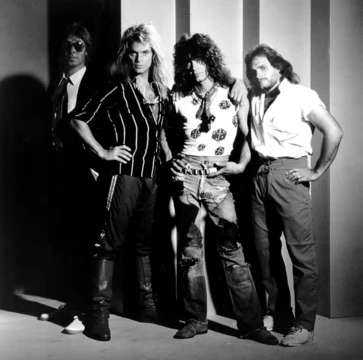
Debut Album Van Halen (1978)
Four kids, one garage, and a guitar that rewrote the rules of rock.

Van Halen's self-titled debut album, released in January 1978 on Warner Bros. Records, is the record that announced the band to the world. Recorded in a remarkably compressed span at Sunset Sound Recorders in Los Angeles and produced by Ted Templeman, it captures four young musicians—Eddie Van Halen on guitar, Alex Van Halen on drums, Michael Anthony on bass and backing vocals, and David Lee Roth on lead vocals—channeling a ferocious, garage-born energy into a polished studio product. The album's blend of hard rock, blues, and a hint of progressive sensibility immediately set it apart from the late-'70s landscape. As the band's first full-length statement, the record established the sonic identity that would define their early career: Eddie's lightning-fast tapping and fluid legato phrasing, Alex's tight and powerful drumming, and Roth's raw, swaggering, and acrobatic vocal delivery. It became a commercial success, charting in the top twenty on the Billboard 200, and served as the springboard from which Van Halen would launch into arena-rock superstardom over the following decade.
- Band lineup
- Eddie Van Halen (guitar), Alex Van Halen (drums), Michael Anthony (bass, backing vocals), David Lee Roth (lead vocals)
Lore & Background
The story of the debut album is inseparable from the story of the Van Halen brothers themselves. Eddie and Alex had been building, breaking, and rebuilding their guitar and drum setups since childhood in Pasadena, and by the mid-1970s they had assembled a band around their shared musical obsession. Michael Anthony brought a blues-soaked vocal and bass foundation, while David Lee Roth, a charismatic frontman with a raw, swaggering voice, gave the group its public face. The chemistry was immediate and volcanic, and the recording sessions reflected that intensity. Eddie's guitar on the album is the centerpiece. His custom instrument—later affectionately known by fans as the 'Frankenstein' guitar—featured a distinctive two-tone body, a Floyd Rose tremolo system, and a configuration that allowed him to play with a speed and fluidity that simply had no precedent in rock music. Tracks like 'Runnin' with the Devil' and 'Ain't Talkin' 'bout Love' showcase a player who treats the guitar not as a lead instrument layered over a rhythm section, but as a full orchestral voice in its own right. The production, guided by Ted Templeman, manages to preserve the live, almost reckless feel of the band's performances while giving them a sheen that made the record radio-friendly without sanding down its edges. The album's broader significance lies in what it proved: that a band with no major-label pedigree, no industry connections, and a sound that defied easy categorization could walk into a studio, record in a matter of days, and walk out with a record that would reshape expectations for what rock guitar could be. For every young guitarist who picked up an instrument in the years that followed, the debut Van Halen album was the moment the ceiling got torn off.
In Their Own Story
The garage on Toluca Lane smelled of solder, stale coffee, and the particular ozone tang of an overdriven tube amp pushed past its comfort zone. Eddie sat cross-legged on the concrete floor, the Frankenstein guitar across his knees, his fingers finding a passage that had no name yet—something between a run and a conversation, notes colliding and resolving in a way that made Alex, three feet away behind his kit, drop his sticks and stare. Michael leaned against the workbench, bass slung low, nodding along to a groove that hadn't been written down anywhere. Sammy stood in the doorway, arms crossed, grinning the grin of a man who'd just heard the future argue with the present. Nobody said a word. They just played, and the walls vibrated, and somewhere down the street a neighbor turned their radio up to try and figure out what the hell that sound was.
Reader's Guide
The debut album's creation arc moves from raw garage rehearsal to studio capture to public release, and each stage shaped the final product. In the rehearsal phase, the four members—Eddie, Alex, Michael, and Sammy—had been locking in their live set for months. The songs were already tight, built around Eddie's guitar interplay with Alex's drums and Michael's bass lines. Sammy's vocal melodies were laid over the instrumental skeletons, and the band's identity as a unit was essentially set before they ever stepped into a professional studio. The recording sessions at Sunset Sound Recorders were famously brief. Ted Templeman, who had been a friend of the brothers since their high school days, guided the sessions with an ear for both polish and spontaneity. The band tracked their parts with minimal overdubs, preserving the live interplay that defined their sound. Eddie's guitar work, in particular, was captured with a directness that let his technique speak for itself. The result was a record that sounded like a band having a great night, not a committee assembling a product. Upon release in January 1978, the album found an audience that was hungry for something more aggressive and technically daring than the prevailing rock landscape. It charted solidly, earned a platinum certification over time, and—most importantly—gave Eddie Van Halen a platform from which his guitar work could be heard by millions. The debut album became the foundational text of the band's mythology: the proof that four kids from Pasadena could walk into the industry and change its rules on day one.
Did You Know?
- The album was recorded in an exceptionally short period at Sunset Sound Recorders, a pace that helped preserve the band's live, unpolished energy.
- Producer Ted Templeman was a Warner Bros. staff producer who discovered the band through a demo and had no prior personal relationship with the Van Halen brothers from their school days.
Frequently Asked Questions
When was Van Halen's self-titled debut album released and who put it out?
The record hit stores in January 1978 under the Warner Bros. Records label. It was the first full-length statement from the band and immediately put them on the radar of rock listeners.
Who produced the original Van Halen album and where was it tracked?
Ted Templeman handled production, and the band recorded at Sunset Sound Recorders in Los Angeles. Notably, the entire tracking session was squeezed into an unusually short window, which fans often cite as a reason the energy on the record feels so raw and urgent.
Who are the four guys on the 1978 Van Halen debut?
Eddie Van Halen plays guitar, Alex Van Halen handles drums, Michael Anthony covers bass and backing vocals, and Sammy Hagar sings lead. It's the classic original four-piece lineup before any personnel changes.
What genres does the Van Halen debut actually blend together?
The album sits at the intersection of hard rock and blues, with a touch of progressive sensibility threaded through some of the longer tracks. That mix helped distinguish the band from the more straightforward hard-rock acts dominating the late-'70s airwaves.
Why do fans consider the 1978 debut such a pivotal record in rock history?
It took the ferocious, garage-born energy the Van Halen brothers had been building in their family garage and channeled it into a tight, polished studio product almost overnight. That contrast—raw power meeting professional sheen—set a template that influenced a generation of guitar-driven rock bands.
More in Story & Timeline
Elsewhere in the Van Halen universe
Spotted an error? Know more?
This is a living reference — every entry is fact-audited, and reader corrections feed straight into our audit queue. Suggest an edit · See this site's audit record