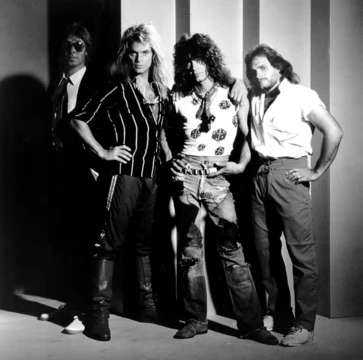
1986: 5150 Released
A new era dawns with Hagar's debut, and the party gets a synthesizer.
1986 marked a pivotal year for Van Halen as the band released their seventh studio album, *5150*, on March 24. This was the first album to feature new lead vocalist Sammy Hagar, following the departure of original frontman David Lee Roth. The album's title, *5150*, refers to a California police code for a mentally disturbed person—a fitting nod to the chaos of replacing a legend—and it also became the name of Eddie Van Halen's home studio. The record showcased a shift in the band's sound, blending hard rock with more melodic and accessible elements, and it was a commercial and critical success, debuting at number one on the Billboard 200 chart.
- Album
- 5150
- Artist
- Van Halen
- Release Year
- 1986
- Lead Vocalist
- Sammy Hagar
- Label
- Warner Bros.
- Genre
- Hard rock, heavy metal
- Producer
- Mick Jones, Donn Landee, Van Halen
Lore & Background
The release of *5150* signaled a transformation for Van Halen, moving from the party-rock anthems of the Roth era to a more polished, radio-friendly hard rock sound. Sammy Hagar, known for his powerful vocals and songwriting from his solo career and Montrose, brought a new dynamic to the band. The album's songs, like 'Why Can't This Be Love' and 'Dreams,' featured prominent synthesizers and layered harmonies, reflecting Eddie Van Halen's growing interest in keyboards and production techniques. This shift divided some longtime fans—who missed Roth's acrobatic showmanship—but attracted a broader audience, cementing the band's place in the mainstream rock landscape of the mid-1980s.
In Their Own Story
The air in Eddie's 5150 studio was thick with anticipation. Sammy Hagar, still finding his footing in the shadow of a legend, watched Eddie's fingers dance across the keyboard, coaxing out a shimmering melody that would become 'Dreams.' The room felt different—less chaotic, more focused. Alex Van Halen's drums pounded with a steady, driving force, while Michael Anthony's bass rumbled underneath. As the final notes faded, Sammy knew they had created something that honored the past but was unmistakably their own. The Van Halen machine was reborn, not from ashes, but from a new, electric energy—and the smell of Hagar's tequila on the mixing board.
Reader's Guide
The album *5150* was recorded at Eddie Van Halen's newly built 5150 Studios in Studio City, California. The band, now with Sammy Hagar, worked with producer Mick Jones of Foreigner and longtime engineer Donn Landee. The recording process was a departure from previous albums, with Hagar's collaborative songwriting style and Eddie's increased use of synthesizers shaping the sound. The album spawned several hit singles, including 'Why Can't This Be Love,' 'Dreams,' and 'Love Walks In,' all of which received heavy MTV rotation. The tour that followed, the 5150 Tour, was a massive success, with shows featuring a mix of new material and classic Van Halen hits, introducing Hagar to the band's live audience. The album's commercial triumph proved that Van Halen could thrive without Roth, and it set the stage for a new chapter in the band's history, often referred to as the 'Van Hagar' era—a label Hagar himself loathed, but the cash register loved.
Did You Know?
- The album's title, 5150, is a California penal code for a person deemed a danger to themselves or others due to mental illness—Eddie thought it was a perfect fit for the band's wild ride.
- Sammy Hagar was introduced to the band through a mutual friend, and he and Eddie Van Halen immediately clicked musically, bonding over a shared love of fast cars and loud guitars.
- The album cover art, featuring a stylized '5150' logo, was designed by artist Pete Angelus, who also helped craft the band's visual identity during the Roth years.
- 5150 was the first Van Halen album to reach number one on the Billboard 200 chart, knocking off Mr. Mister's 'Welcome to the Real World' and proving the band could dominate without Roth.
More in Story & Timeline
Elsewhere in the Van Halen universe
Spotted an error? Know more?
This is a living reference — every entry is fact-audited, and reader corrections feed straight into our audit queue. Suggest an edit · See this site's audit record