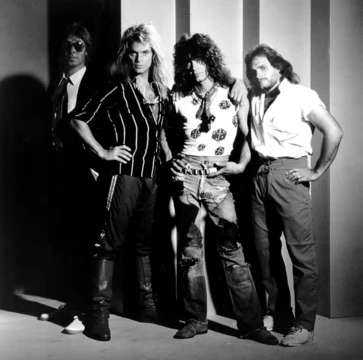
Red Rocks Amphitheatre
Where ancient stone meets electric fury and the whole canyon shakes.

Red Rocks Amphitheatre, perched in the high-desert canyons of Morrison, Colorado, is one of the most electric outdoor stages in American rock history. For Van Halen, it became a rite of passage: a place where the band's raw, high-octane sound collided with the resonant acoustics of ancient sandstone and granite, turning every show into something that felt less like a concert and more like a geological event. Fans who caught Van Halen at Red Rocks in the late '70s and again in later decades often describe the experience as the band's music made physically real, the rocks themselves vibrating in sympathy with Eddie Van Halen's guitar. It is the venue where the crowd becomes a single roaring organism, where the natural bowl of the amphitheater focuses every note into a chest-thumping clarity, and where the memory of a single night can define a fan's relationship with the music for a lifetime.
- Location
- Morrison, Colorado (south of Denver)
- Type
- Natural outdoor amphitheater
- Geology
- Red sandstone and granite formations
- Van Halen appearances
- Multiple performances from the late 1970s through the 2000s
- Atmosphere
- Open-air, canyon-bowl setting with natural acoustics
- Status
- Active concert and event venue
Lore & Background
The story of Van Halen at Red Rocks is, in many ways, the story of the band finding a stage that matched their energy. In the late 1970s, when the group was still building its reputation on relentless touring and a sound that seemed to defy the physics of amplification, Red Rocks offered something no indoor club or arena could: a vast, open bowl of natural rock that threw sound back at the audience with a warmth and immediacy that felt almost sacred. The band's early shows there were legendary in fan circles—Eddie's guitar work seemed to make the sandstone hum, and the crowd, packed into the sloping grass and stone tiers, became part of the instrument itself. Over the following decades, Van Halen returned to the venue at various points in their career, each visit marking a different chapter. By the time they played Red Rocks in later years, the audience included fans who had been there in the '70s and were now bringing their own children, creating a multigenerational wall of sound and memory. The venue's natural acoustics meant that even the subtlest harmonic overtones in a Van Halen riff could be felt in the chest, and the open sky above turned every encore into a communion with the Colorado night. For the Van Halen fan community, Red Rocks occupies a special place in the pantheon of great show venues—not quite the same as the Wembley or the Forum, but carrying its own mythic weight. It is the venue where the American West's landscape becomes a character in the music, where the red rocks glow under stage lights like embers, and where the band's identity as a force of pure, unfiltered sonic joy felt most fully realized.
In Their Own Story
The bus had barely rolled to a stop when the smell hit—dry sage, hot stone, the faint metallic tang of dust kicked up by the afternoon sun. Eddie stepped out, adjusted his shades, and looked up at the canyon walls. They blazed orange in the late light, and he could already hear the faint echo of the soundcheck bleeding off the rock face. "This place," he muttered to Alex, "this place don't need a PA." Alex grinned, already unloading the amplifier stack. They had a few hours before the gates opened, and the crowd was already a thin river of bodies winding up the access road, their voices a distant hum that mixed with the wind through the pines.
Reader's Guide
Red Rocks Amphitheatre is a natural outdoor concert venue in Morrison, Colorado, roughly fifteen miles south of Denver. The "stage" is a natural rock formation, and the audience sits on sloping grass and stone tiers that curve around the performance area in a rough semicircle. The venue's defining feature is its geology: towering walls of red sandstone and granite that create a natural acoustic bowl, reflecting and focusing sound in a way that makes every performance feel physically immersive. In the Van Halen story, Red Rocks matters because it represents the band at full physical force in a setting that amplifies that force. The open-air, canyon-bowl environment means the audience is surrounded by sound, not just facing it, and the natural resonance of the stone adds a layer of warmth that no engineered venue can replicate. For fans, catching Van Halen here meant experiencing the music as a landscape event—something that happened to you as much as for you. The venue has been hosting live performances since the early 1940s and remains one of the most sought-after concert locations in the United States. Its capacity is modest by arena standards, which means the crowd-to-stage ratio is intimate even at full house. For a Van Halen show, that intimacy combined with the raw power of the band's live sound created an experience that fans still describe in almost spiritual terms years later.
Did You Know?
- Red Rocks is not a constructed building but a natural canyon formation; the 'stage' is a flat rock shelf and the seating is the sloping terrain around it, meaning the venue has existed for millions of years before it hos
- The red color of the sandstone comes from iron oxide deposits, and the rocks glow a deep, almost luminous orange under warm stage lighting—a visual effect that became a signature of Van Halen's shows there.
- Because the amphitheater is open-air with no roof, weather has historically been a factor in scheduling; a summer thunderstorm rolling through the Colorado foothills can turn a Van Halen set into a rain-soaked, lightning
- The natural acoustics of the canyon walls mean that even a single guitar note played at the stage can produce a faint, rolling echo off the distant rock face, a detail that Eddie Van Halen reportedly found inspiring duri
More in World & Setting
Related in Van Halen
Links follow this subject's own source article.
Elsewhere in the Van Halen universe
Spotted an error? Know more?
This is a living reference — every entry is fact-audited, and reader corrections feed straight into our audit queue. Suggest an edit · See this site's audit record