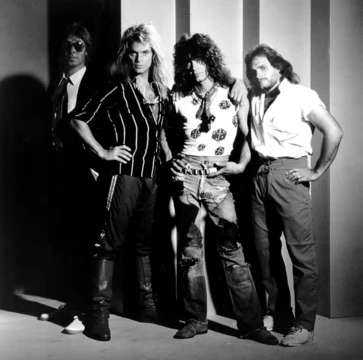
Los Angeles, California
Where a garage in Pasadena became the thunderous birthplace of a rock revolution.

Los Angeles, California — and its sprawling suburbs like Pasadena — is the geographic heart of the Van Halen story. It is where the Van Halen brothers built their guitars in a family garage, where they first plugged in and shook the floorboards of small clubs, and where the city's electric, sun-soaked energy became inseparable from the sound they created. For fans, LA is not merely a backdrop; it is the soil from which the band grew, the proving ground for a sound that would reshape rock music, and the cultural landscape that defined an era of hard rock. From the early 1970s through the 1980s and well beyond, the greater Los Angeles area served as the band's home base, the wellspring of their earliest gigs, and the crucible in which their signature style was forged. The city's blend of garage-band grit, studio ambition, and relentless live energy is woven into every chapter of the band's history, making LA as central to the Van Halen identity as the guitars themselves.
- Band formed
- 1974
- Founding members
- Eddie Van Halen, Alex Van Halen, Mark Stone
Lore & Background
The Van Halen story begins not in a boardroom or a major label office, but in a modest family garage in Pasadena, a suburb nestled in the greater Los Angeles basin. Eddie and Alex Van Halen, sons of Dutch immigrants who had settled in the area, spent their teenage years surrounded by guitar parts, amplifiers, and the hum of electricity. That garage became a workshop, a rehearsal space, and a laboratory where Eddie's revolutionary two-handed tapping technique was born and where the distinctive "Frankenstrat" guitar was assembled from mismatched parts. The LA landscape — its palm-lined streets, its sprawl of recording studios, its dense network of small clubs — provided the ecosystem in which a garage band could test ideas nightly, refine a sound, and eventually crack open the national market. Los Angeles in the late 1970s was a particularly fertile ground for hard rock. The city hosted a constellation of bands pushing the genre's boundaries, and the local club scene offered a constant stream of opportunities for young musicians to play, compete, and evolve. Van Halen emerged from this competitive, energetic milieu, and their early shows in the LA area were legendary for their sheer physical intensity. The city's culture of spectacle, its proximity to Hollywood's production machinery, and its audience appetite for loud, theatrical rock all fed directly into the band's identity. Even as the band's fame carried them to arenas and stadiums around the world, Los Angeles remained a gravitational center. Studio sessions, songwriting retreats, and the daily rhythms of band life were anchored in the LA area for decades.
In Their Own Story
It is a Tuesday night in late summer, and the air over Pasadena smells of hot asphalt and eucalyptus. Inside a two-car garage with the door half-raised, a single workbench lamp throws a cone of amber light over a guitar that has no name yet — just a mismatched body, a hand-wired neck, and a tremolo arm that wobbles when you look at it. Eddie is on his back on the concrete floor, soldering a jack, his fingers black with rosin. Alex is behind a drum kit that looks like it was salvaged from a pawnshop, tapping out a rhythm with brushes on a snare that has a tear in its head. The walls are plastered with flyers for shows at the Whisky a Go Go and the Starwood, some of them peeling at the corners. A half-empty bottle of Jack Daniel's sits on a crate next to a stack of 8-track tapes. Outside, a neighbor's sprinkler hisses against a fence. This is not a recording studio. This is not a stage. This is a garage in a quiet suburban neighborhood, and the sound bleeding through the cracks in the door is the sound of something being built from scratch — a riff that will one day echo through stadiums, a tone that will make a million kids pick up a guitar. But right now, it's just Eddie and Alex, the hum of the soldering iron, and the promise of a Tuesday night that refuses to end.
Reader's Guide
Los Angeles, California, is the foundational setting of the Van Halen story. The band formed in 1972 in Pasadena, a suburb in the greater LA area, and the city's music infrastructure — its garages, its small clubs, its recording studios, and its audience of rock-hungry locals — provided the environment in which their sound was developed and honed. In the band's narrative, LA serves three roles. First, it is the origin point: the family garage where Eddie built his instruments and the brothers rehearsed until their ears rang. Second, it is the proving ground: the local venue circuit where they played night after night, building the relentless live energy that became their trademark. Third, it is the cultural backdrop: a city in the late 1970s and 1980s that was a global capital of hard rock, where the expectations and competition pushed the band to innovate constantly. For fans, understanding LA's role means understanding that Van Halen was not a transplanted band or a studio invention. They were a product of a specific place, a specific community of musicians, and a specific moment in American music history. The city's energy, its sprawl, and its appetite for spectacle are embedded in the band's identity in a way that no other setting could replicate.
Did You Know?
- The Van Halen family emigrated from the Netherlands; Eddie and Alex were both born there before moving to the United States as children and growing up in the Los Angeles area.
- Eddie Van Halen's iconic 'Frankenstrat' guitar was built in the family garage in Pasadena from a collection of mismatched parts, and it became the instrument on which many of the band's earliest and most influential guit
- The greater Los Angeles area in the late 1970s was home to a dense cluster of hard-rock and heavy-metal bands, creating a competitive local scene that pushed each act to raise the bar in both musicianship and stage prese
- The band's early years involved playing at small, often scrappy venues in the LA area, building a reputation for physically intense, extended live performances well before they achieved national chart success.
Frequently Asked Questions
Where exactly did Van Halen form and why does that matter to fans?
The band came together in 1972 in Pasadena, a suburb in the greater Los Angeles area. For longtime fans, that specific garage in the Van Halen family home is the origin point of everything—the place where Eddie and Alex first wired up their instruments and started the sound that would eventually redefine electric guitar playing.
What was the LA hard-rock scene like when Van Halen first hit the clubs?
The late-1970s Los Angeles club circuit was a dense, competitive environment of hard rock and heavy metal acts all vying for the same audiences. That pressure cooker of rival bands and high-energy shows forced the Van Halen brothers to keep escalating their technical speed and sonic aggression night after night.
Why do fans treat Los Angeles as almost a character in the Van Halen story?
LA was simultaneously the physical workshop, the proving ground, and the cultural backdrop that shaped the band's identity from the mid-1970s through the 1980s. The city's sun-soaked, sprawling energy became inseparable from the sound the brothers created, making the setting feel as essential to the mythology as any single song.
Where did Eddie Van Halen build his first guitar and develop his tapping technique?
Eddie assembled his iconic Frankenstein guitar in the Van Halen family garage in Pasadena during the early 1970s. That same cramped space served as the lab where he prototyped the two-handed tapping approach and the high-gain rig that would become his signature.
How did the Southern California setting distinguish Van Halen from other rock acts of the era?
The band's visual and cultural identity drew heavily from the bright, high-energy, showmanship-driven atmosphere of the LA scene rather than the darker aesthetics of British or New York rock. That local flavor—sprawling suburbs, garage workshops, and a relentless club circuit—gave them a distinctively American, sun-bleached hard-rock image from the very first shows.
More in World & Setting
Related in Van Halen
Links follow this subject's own source article.
Elsewhere in the Van Halen universe
Spotted an error? Know more?
This is a living reference — every entry is fact-audited, and reader corrections feed straight into our audit queue. Suggest an edit · See this site's audit record