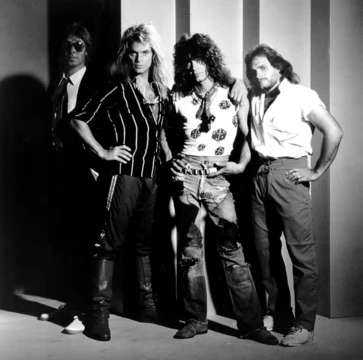
1982: Diver Down Released
A boozy, cover-heavy snapshot of Van Halen at their most recklessly fun—and fraying at the edges.
1982's *Diver Down* is the fifth studio album by Van Halen, released during a period of relentless touring and simmering creative tension. It stands as a covers-heavy jukebox that captures the band's raw, party-rock energy, even as internal fault lines began to crack. The album's role in the Van Halen timeline is that of a transitional work—a slightly sunburned pit stop between the brooding art-metal of *Fair Warning* and the more expansive sounds to come.
- Artist
- Van Halen
- Album
- Diver Down
- Release Year
- 1982
- Genre
- Hard rock, heavy metal, pop rock
- Label
- Warner Bros.
- Producer
- Ted Templeman
Lore & Background
Following the darker, more experimental *Fair Warning*, *Diver Down* saw Van Halen swerve back toward a straightforward, fun-loving approach—think beach bonfire, not brooding storm. The album is notorious for its heavy reliance on cover songs, including a hit version of Roy Orbison's 'Oh, Pretty Woman' and a medley that smashes 'Dancing in the Street' into 'Happy Trails.' This decision was partly driven by time constraints—the band had only a few weeks between tours—and partly by a desire to keep the party rolling, but it also reflected growing creative friction between Eddie Van Halen and lead singer David Lee Roth. Eddie later admitted he felt the covers were a step backward, while Roth saw them as crowd-pleasing rocket fuel.
The album's title and cover art—a diver plunging into blue water, legs splayed, catching the light—evoke a sense of reckless abandon and summer fun, perfectly matching the record's vibe. Despite its lighter tone, *Diver Down* contains some of the band's most beloved deep cuts: the instrumental 'Cathedral,' a shimmering, cathedral-like guitar piece that sounds like stained glass made of electricity, and the hard-driving 'Hang 'Em High,' a galloping original that channels spaghetti western dust. It was a commercial success, reaching multi-platinum status and producing several MTV hits, but it also marked the point where the band's internal friction began to surface more openly—like cracks in a pool's plaster.
For fans, *Diver Down* is a snapshot of Van Halen at a crossroads: still capable of delivering high-energy rock anthems, but already showing signs of the creative divergence that would eventually lead to Roth's departure. It remains a cherished, if sometimes debated, entry in their catalog—a beer-soaked time capsule of a band teetering on the high dive.
In Their Own Story
The studio hums with the smell of stale beer and amplifier tubes. Eddie Van Halen, fingers bleeding from a night of practice, lays down a riff that sounds like a carnival on fire—all whammy bar dive-bombs and fractured harmonics. Dave, barefoot and wearing a sequined jacket that catches the fluorescent light like a disco ball, argues with Ted Templeman about the track listing. 'No, no, no,' Dave says, pointing at a cassette. 'This one. 'Pretty Woman.' It's a hit. Trust me.' Alex Van Halen pounds a drum fill that rattles the windows and shakes dust from the ceiling tiles. Michael Anthony, ever the peacemaker, suggests a medley—'Dancing in the Street' and 'Happy Trails'—to fill space and keep everyone happy. The tape rolls. The dive begins.
Reader's Guide
The album opens with 'Where Have All the Good Times Gone!', a Kinks cover that sets the nostalgic yet energetic tone—like a jukebox from a dive bar that's been kicked into overdrive. 'Hang 'Em High' follows, a galloping original that channels spaghetti western vibes, complete with Eddie's twangy, gun-slinging guitar. 'Cathedral' is a haunting guitar solo piece—a solo guitar piece, really—that showcases Eddie's innovation, building layers of delay and reverb into something that sounds like a pipe organ made of molten steel. 'Secrets' offers a mellow, melodic break, with Roth crooning like a beach bum reading a love letter. Side two kicks off with 'Intruder,' a dark, atmospheric intro—all eerie synth and whispered menace—leading into the massive hit 'Oh, Pretty Woman,' where Eddie's riff hits like a sledgehammer wrapped in velvet. The band's take on 'Dancing in the Street' is a raw, party-ready cover, complete with handclaps and a sense that the whole thing might fall apart at any second. 'Little Guitars (Intro)' is a brief, flamenco-tinged acoustic piece that leads into the full track 'Little Guitars,' a rocker that sounds like a Spanish fiesta crashing into a stadium show. 'Big Bad Bill (Is Sweet William Now)' is a surprising vaudeville-style duet between Eddie on piano and his father Jan on clarinet—a tender, almost vaudeville moment that feels like a family secret let out of the closet. 'The Full Bug' brings back the hard rock swagger, with Roth snarling about a woman who's 'the full bug'—whatever that means, you know it's trouble. The album closes with 'Happy Trails,' a ragged, fun cover that sends listeners off with a grin and a beer-stained wave.
Did You Know?
- The album's title was inspired by a sign David Lee Roth saw at a pool that read 'No Diving,' which he misread as 'Diver Down.'
- Eddie Van Halen's father, Jan Van Halen, played clarinet on 'Big Bad Bill (Is Sweet William Now).'
- The cover of 'Oh, Pretty Woman' was so successful that it helped revive interest in Roy Orbison's original version.
- The album was recorded in just a few weeks, partly because the band was on a tight schedule between tours.
More in Story & Timeline
Elsewhere in the Van Halen universe
Spotted an error? Know more?
This is a living reference — every entry is fact-audited, and reader corrections feed straight into our audit queue. Suggest an edit · See this site's audit record