2000 Watt Stand
Three words for the moment the floor stops being solid and starts being sound.

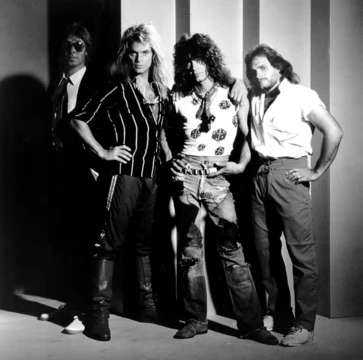
"2000 Watt Stand" is a fan-coined epithet that has become a shorthand in Van Halen fandom for the sheer, almost physical force of the band's live amplification and stage energy—particularly the towering amp stacks and the way Eddie Van Halen's guitar cut through a venue like a blade through fog. It is not an official title, track, or album; rather, it is a piece of fan lore that captures the mythos of a Van Halen concert: the hum of high-powered tubes before the first note, the way the backline seemed to occupy its own gravitational field, and the collective gasp of a crowd that felt the floorboards rearrange themselves. In fan circles, the phrase evokes the era when the band's live shows were as much about raw sonic architecture as they were about melody—Eddie's custom instrument, the wall of amplification behind him, and the kinetic interplay with Michael and Alex Van Halen that made a stadium feel like a single breathing organism. It is the sound and spectacle distilled into three words that fans use to describe what it felt like to stand in the pit when the guitar screamed.
- Origin
- Fan-coined nickname (not an official Van Halen title)
- Primary subject
- Eddie Van Halen's live amplification and stage power
- Associated era
- 1970s–1980s peak touring years
- Associated band
- Van Halen
- Cultural role
- Symbol of high-wattage rock spectacle in fan discourse
Lore & Background
The phrase lives in the gap between what a spec sheet says and what a body feels. Eddie Van Halen's guitar—his hand-built, wire-wound, two-handed-tapping Frankenstein of an instrument—was never just a guitar in the way a factory-finished Les Paul is a guitar. It was a signal source of almost violent clarity, and the amplification behind it was engineered to preserve every harmonic overtone at volumes that made nearby glass vibrate. Fans who attended shows in the late '70s and throughout the '80s often described the experience not as hearing music but as being inside a machine that happened to be playing. "2000 Watt Stand" is their way of naming that machine. The term also carries a generational weight. For fans who grew up on bootleg recordings and VHS tapes of Van Halen live sets, the image of Eddie standing behind a wall of glowing tubes, his headstock catching the stage lights while his fingers moved in patterns that seemed to violate the physics of fretting, became a touchstone. The "stand" in the phrase is both literal—the physical amp stack on its road case—and metaphorical: the unshakeable position of the band as the loudest, most technically reckless act in rock at any given moment. It is the sound of a genre asserting its own volume ceiling. In fan-written histories and forum threads, "2000 Watt Stand" often appears as a chapter heading or a section title when discussing the sensory experience of a Van Halen concert: the pre-show hum, the way the first chord of a song like "Runnin' with the Devil" or "Panama" would hit the chest before the ears registered pitch, the way the pit became a single organism moving in time with the downstrokes. It is lore built from collective memory rather than a single documented event.
In Their Own Story
The house lights die and the room goes to a low, electric murmur—the kind of quiet that isn't quiet at all. You can hear the amp hum before anyone plays: a thick, 60-cycle drone that vibrates in your molars, rattling the fillings you didn't know you had. Eddie is already behind the stack, tuning, his fingers brushing the strings with a whisper that somehow carries through the crackling air. Then he hits an open A—and it's not a note, it's a physical event. The floorboards lift, the beer in your cup ripples, and the guy next to you grabs your shoulder because his knees just buckled. That's the 2000 Watt Stand: the moment the music stops being something you hear and starts being something you hold onto.
Reader's Guide
If you are new to Van Halen fan culture and encounter the phrase "2000 Watt Stand," know that it is not a song, an album, or an official band designation. It is a fan-coined expression that has stuck in forums, fan-fiction, and informal discussions as a way to talk about the physical, almost architectural power of a Van Halen live performance. The term centers on Eddie Van Halen's role as the band's sonic engine. His custom-built guitar, his two-handed tapping technique, and the high-powered tube amplification he used on tour created a sound that was as much felt as heard. Fans who experienced those shows describe a particular quality: the music seemed to have weight, to occupy space, to press against the body. "2000 Watt Stand" is their shorthand for that experience. You will find the phrase most often in contexts discussing the band's 1970s and 1980s touring era, the design of Eddie's guitar and rig, and the cultural impact of Van Halen as a live act. It is affectionate, slightly mythologized, and entirely rooted in the genuine awe that a high-powered rock show can inspire. Think of it as the fan equivalent of saying "the sound system was a living thing."
Did You Know?
- Eddie Van Halen's signature guitar, often called the 'Frankenstrat,' was a hand-built instrument with a custom neck, a wire-wound string on the high E, and a body he shaped himself—making it as much a sculpture as a musi
- The band's 5150 amplifier head, later produced by Marshall, was named after Eddie's Los Angeles zip code, tying the hardware directly to his personal geography.
- Eddie's two-handed tapping technique, prominently featured on tracks like 'Eruption' and 'Cathedral,' was largely self-taught and was considered virtually unheard of in mainstream rock when the band broke through in the
- Van Halen's early live shows were notorious for their volume and energy, and the band's reputation as a physically overwhelming stage act was a major part of their identity from the very beginning of their touring career
More in Lore & History
Elsewhere in the Van Halen universe
Spotted an error? Know more?
This is a living reference — every entry is fact-audited, and reader corrections feed straight into our audit queue. Suggest an edit · See this site's audit record