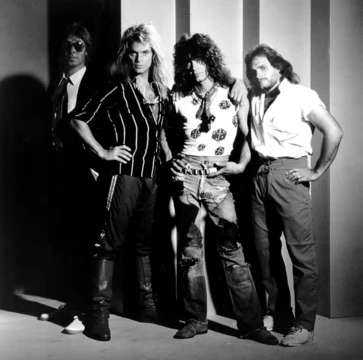
The Van Halen Name
Three syllables, two brothers, and a sound that rewired the electric guitar forever—then left the schematic on the floor for anyone brave enough to pick it up.

The name 'Van Halen' is far more than a label stitched onto a tour jacket—it is the beating heart of one of rock music's most iconic identities. Rooted in a Dutch family surname carried across the Atlantic by two brothers, the name became inseparable from Eddie Van Halen's revolutionary guitar work, his relentless studio experimentation, and the ferocious energy he poured into every performance. To fans worldwide, the three syllables carry the weight of a sound that redefined what an electric guitar could do—a sound that could erupt from a single amplifier and fill a stadium with a roar that felt both alien and intimate. As a fan-encyclopedia subject, 'The Van Halen Name' explores how a family heritage, a sibling bond, and a single creative vision fused into a brand that outlived its members' lifetimes. It is a name that functions simultaneously as a personal identity, a musical manifesto, and a cultural touchstone for generations of guitarists who picked up an instrument because of it—often with a battered copy of 'Van Halen I' spinning in the background, trying to figure out how one pair of hands could make those sounds.
- Origin
- Dutch family surname (Van Halen)
- Primary namesake
- Eddie Van Halen — lead guitarist, primary songwriter, creative force
- Sibling namesake
- Alex Van Halen — drummer, co-founder
- Band formed
- 1978, Pasadena, California
- Heritage
- Parents of Dutch descent; brothers born in the Netherlands
- Status
- Name endures as a permanent fixture in rock history following Eddie's passing in 2020
Lore & Background
The Van Halen surname is Dutch in origin, a family name carried by Jan and Bea Van Halen, who emigrated to the United States and raised their sons in a modest home where music was as natural as breathing. Eddie, the younger brother, and Alex, the older, both absorbed the rhythms of their parents' world before Eddie's ear for electronics and his restless hands turned a cheap guitar into a laboratory. The name, therefore, was never a marketing decision or a borrowed stage persona. It was simply who they were—two brothers with a shared last name who walked into a rehearsal space in Pasadena and decided the world needed to hear what Eddie could do with two hands on the fretboard. Choosing to keep the family name rather than inventing a flashy rock moniker gave the band an unusual groundedness from day one. In a genre saturated with invented identities, 'Van Halen' sounded like a real person's name, which paradoxically made the music feel more mythic. Eddie's playing was so far beyond the conventions of the late 1970s that audiences often struggled to believe a single human being was producing those sounds. The name anchored the spectacle in reality: this was a guy from a Dutch-American household in Southern California, tapping strings with both hands and making a Fender Stratocaster scream in ways no one had heard before. After Eddie's death in 2020, the name entered a new chapter of fan reverence. It became a memorial, a standard, a shorthand for a particular kind of fearless musical ambition. Alex continued to carry the name in interviews, tribute shows, and archival releases, treating it less as a brand to protect and more as a legacy to honor. For the fan community, 'Van Halen' remains a living word—spoken in guitar shops, shouted in arenas, typed into search bars by teenagers discovering the music for the first time.
In Their Own Story
The rehearsal space smelled like solder flux and stale coffee. Eddie sat cross-legged on the carpet, a half-disassembled pickup in his lap, while Alex drummed softly on a practice pad, keeping time like a metronome with a pulse. The whiteboard on the wall still read 'Million Dollar Quartet' in faded marker. Michael Anthony leaned against a stack of empty beer cans, noodling a bass line that seemed to vibrate through the floorboards. Nobody had said the band's name out loud in weeks—it just hung in the air, as natural as the dust motes drifting in the afternoon light. When Eddie finally looked up, his fingers still working a tiny screwdriver, he muttered, 'Van Halen. That's it. That's all we need.' Alex didn't even pause his drumming; he just nodded, a faint smile cracking through his concentration. The name was already theirs—had always been theirs—and in that cramped room, with the smell of burnt solder and the promise of something no one had ever heard before, it became a declaration of war on everything predictable about rock music.
Reader's Guide
The Van Halen name is the family surname of Dutch origin that two brothers, Eddie and Alex, carried into the rock world in 1978. It was not a chosen stage name but a genuine identity, and that authenticity became part of the band's mythology from the start. Eddie, the younger brother, was the musical architect. His two-handed tapping technique, his obsessive studio production, and his relentless pursuit of new guitar sounds made the name synonymous with innovation. Alex, the drummer, provided the rhythmic engine that let Eddie's ideas land with full force. Together, under their shared surname, they built a sound that was immediately recognizable and difficult to imitate. The name's Dutch roots give it a quiet, almost understated quality that contrasts sharply with the explosive music it represents. In a genre that thrives on theatrical personas, 'Van Halen' sounds like a neighbor's name, which somehow made the spectacle more extraordinary. For fans, the name functions as a portal. Mention it in a guitar shop and you'll get a nod. Play a few notes in the style of Eddie's phrasing and a room will go quiet. The name carries decades of riffs, arena anthems, and the memory of a guitarist who treated the instrument like a living thing to be argued with. It remains, for those who love it, a name that still hums.
Did You Know?
- The Van Halen brothers were both born in the Netherlands before their family emigrated to the United States, making the band's iconic name a direct inheritance from a Dutch household.
- Eddie Van Halen's two-handed tapping technique was so novel in the late 1970s that many listeners initially assumed the rapid passages on his recordings were produced by multiple guitarists or studio tricks.
- The name 'Van Halen' has never been trademarked as a generic rock brand; it remains tied to the specific individuals who bore it, which is why its meaning shifted profoundly after Eddie's passing in 2020.
More in Lore & History
Elsewhere in the Van Halen universe
Spotted an error? Know more?
This is a living reference — every entry is fact-audited, and reader corrections feed straight into our audit queue. Suggest an edit · See this site's audit record