5150
A 5150 phone call, a new frontman, and the loudest riff of '86.

Daniel Balsom · CC BY-SA 4.0
5150 is the seventh studio album by the American rock band Van Halen, released in 1986. Named after the California Welfare and Institutions Code section governing involuntary psychiatric holds, the record became one of the band's most recognizable works and a defining artifact of the late-'80s hard rock landscape. It is the album that marked the debut of new lead singer Sammy Hagar, ushering in a new era for the band. For fans, 5150 represents the moment Van Halen's raw, garage-born energy met a more polished, radio-ready production without losing its swagger. Tracks like "Why Can't This Be Love" and "Dreams" became anthems that still define the band's live shows decades later, and the album's cover—a striking geometric design of red, black, and white—remains one of the most instantly recognizable images in rock history.
- Type
- Studio album
- Artist
- Van Halen
- Release year
- 1986
- Album number
- Seventh studio album
- Signature instrument
- Eddie Van Halen's 'Frankenstein' guitar
- Notable track
- "Why Can't This Be Love"
- Title origin
- California Welfare & Institutions Code §5150 (involuntary psychiatric hold)
Lore & Background
The name 5150 was not chosen as a random number. In California, dialing 5150 connects you to a mental-health crisis line, and the Welfare and Institutions Code section 5150 governs involuntary psychiatric holds. The band leaned into that slightly unhinged, high-wire energy to describe the state of mind behind the record. It was a tongue-in-cheek nod to the chaos of the studio and the wildness of Eddie's playing, a label that stuck because it perfectly captured the band's self-aware, irreverent personality. The visual centerpiece of 5150 is not a guitar but a bold geometric cover—a red, black, and white abstract design that broke from the band's earlier album art traditions. Eddie Van Halen's Frankenstein guitar, a heavily modified, custom-built instrument with a distinctive asymmetrical body, a single humbucker pickup, and a stripped-down, almost brutal aesthetic, was famously featured on the previous album 1984 and was also used extensively on 5150. Eddie had been building and modifying guitars in his family's garage in Pasadena for years, and while the Frankenstein remained his primary instrument throughout the 5150 sessions, its absence from the album cover allowed the stark, modern design to stand on its own. Musically, 5150 sits at a crossroads in Van Halen's catalog. The band retained Eddie's signature tapping and harmonic-dominant solos, but the production was tighter and the songwriting more direct with Hagar's melodic vocals. "Why Can't This Be Love" became a radio staple and a concert highlight, while tracks like "Dreams" and "Love Walks In" showcased the band's ability to write melodic, almost pop-adjacent hooks over a wall of distorted guitars. The album cemented Van Halen's status as one of the defining hard-rock acts of the 1980s and proved the band could thrive without original frontman David Lee Roth.
In Their Own Story
The studio was quiet except for the hum of a half-warmed amp. Eddie sat cross-legged on the carpet, the Frankenstein resting across his knees like a sleeping animal. He wasn't playing. He was just listening to the silence between the strings, the way the single pickup breathed when you tapped the wood. Alex poked his head in from the control room, headphones dangling around his neck, and said nothing—just nodded. That was the whole conversation. Eddie plugged in, hit the first E, and the room filled with a sound like a freight train deciding to change its mind mid-track. By the time the last harmonic faded, Alex was already reaching for the fader. "Again," he said. "But louder." And the tape rolled.
Reader's Guide
5150 is Van Halen's third studio album, released in 1986, and it marks the point where the band's garage-rock origins fully collided with mainstream rock production. The title references California's 5150 mental-health code, a nod the band made with their usual deadpan humor. The album is instantly recognizable by its cover: Eddie Van Halen's Frankenstein guitar, a custom-built, single-humbucker instrument with a raw, asymmetrical body that Eddie had been refining in his Pasadena garage. By 5150 it was his go-to rig, and the image became inseparable from the band's brand. Musically, the record blends the band's signature twin-guitar interplay with a more direct, radio-friendly songcraft. "Panama" became a defining live anthem, while "Top of the World" and "Infinite" showed the group's knack for melodic hooks over a wall of overdriven guitars. Eddie's tapping, harmonics, and aggressive picking are front and center throughout. For fans, 5150 represents the sweet spot of Van Halen's early era: the energy of their first two records, the polish of a major-label machine, and the irreverent personality that kept the whole thing from feeling corporate. It is the album where the Frankenstein guitar stopped being a workshop curiosity and became a rock-and-roll symbol.
Did You Know?
- The album's title refers to California Welfare and Institutions Code section 5150, which governs involuntary psychiatric holds—a number you can dial as a mental-health crisis line.
- 5150 was the first Van Halen album to feature Sammy Hagar on lead vocals, replacing David Lee Roth.
- The album cover is a geometric design of red, black, and white—not a guitar—marking a visual departure from the band's earlier album art.
The Hagar Transition & Album Creation
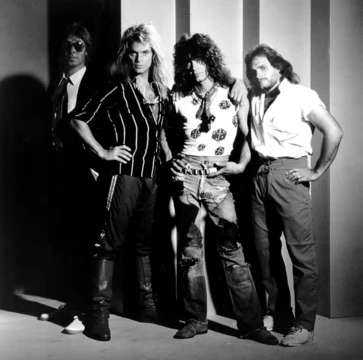
Finding a successor to David Lee Roth proved an unexpectedly arduous process for Van Halen. The breakthrough came in July 1985, when a mechanic servicing Eddie Van Halen's Lamborghini suggested the name of former Montrose frontman Sammy Hagar. The two hit an immediate rapport, and the band dove into songwriting by November of that year, completing the record by February 1986. Warner Bros. Records issued the finished product on March 24, 1986, making it the first of four studio records the group would record with Hagar at the helm. The title itself carries a peculiar origin: it references Eddie's home studio, which in turn borrows its name from Section 5150 of the California Welfare and Institutions Code, a law-enforcement designation for a mentally disturbed individual. The album also marked a structural first for the band, becoming their first release to exceed thirty-six minutes in runtime and their first to contain no purely instrumental tracks.
Production & Musical Identity Shift
The arrival of Hagar fundamentally altered Van Halen's sonic palette. Where earlier records leaned into straightforward heavy rock, 5150 introduced a wave of love songs and ballads that split fans and critics alike. The moniker "Van Hagar" became so entrenched in public discourse that Warner Bros. reportedly floated the idea of officially rebranding the band under that name, a suggestion the Van Halen brothers flatly rejected. Behind the console, the departure of long-time producer Ted Templeman, who had helmed every prior Van Halen record before pivoting to David Lee Roth's solo project Eat 'Em and Smile, opened the door for a new approach. Donn Landee, who had previously served as an engineer on earlier albums, stepped into the producer role alongside Foreigner guitarist Mick Jones. Landee, uninterested in the "live mix" aesthetic that had characterized past records, repositioned Eddie's guitar from its traditional dominance in the left channel to a more balanced placement within the overall mix, giving the album a distinctly different texture.
Critical Reception & Lasting Legacy
Initial reviews of 5150 were decidedly mixed. Robert Christgau of The Village Voice awarded it a C+, questioning how guitar purists would react to Hagar replacing Roth and suggesting that no musician with genuine artistic intent could stomach Hagar's vocal style. Tim Holmes at Rolling Stone gave it three out of five stars but praised Eddie's "cheeky genius" in balancing complex orchestration with rock simplicity, calling the record a showcase of a band at its peak. Yet time has been generous. AllMusic's Stephen Thomas Erlewine, writing retrospectively, highlighted the pronounced tonal shift from Roth's tongue-in-cheek persona to Hagar's more earnest delivery, while crediting Hagar with injecting "a previously unheard sense of discipline" into the songwriting. He called 5150 "a pretty impressive opening act for Van Halen Mach II." In October 2023, Donn Landee remastered the album for inclusion in The Collection II, a box set pairing all four Hagar-era records with a disc of eight rarities, ensuring the record remains accessible to new generations of listeners.
Tour & Performance Reimagining
The 5150 tour represented a dramatic departure from Van Halen's previous live shows. Hagar, uncomfortable performing a large catalog of songs written for a different frontman, pushed the band to strip most of the Roth-era material from their set lists. Instead, concerts featured nearly the entire 5150 record, supplemented by a couple of Hagar solo hits, "I Can't Drive 55" and "There's Only One Way to Rock," and a cover of Led Zeppelin's "Rock and Roll." The band even wove a humorous verse of Robert Palmer's "Addicted to Love" into their rendition of "Best of Both Worlds." Only three Roth-era tracks, "You Really Got Me," "Panama," and "Ain't Talkin' 'bout Love," remained regular fixtures. A notable consequence of this lineup change: because Hagar was himself an accomplished guitarist, Eddie Van Halen was freed to take on keyboard duties during certain songs, a role he had never previously filled in a live Van Halen context. The tour was documented in the live video Live Without a Net, later released on DVD.
Gallery

Frequently Asked Questions
What is 5150?
5150 is Van Halen's third studio album, released in 1986. It stands as one of the band's most recognizable records and a defining artifact of the late-'80s hard rock era.
Why is the album called 5150?
The title comes from section 5150 of the California Welfare and Institutions Code, the statute governing involuntary psychiatric holds. The number went on to become a pop-culture shorthand for 'crazy' well beyond the record itself.
What's the Frankenstein guitar's connection to 5150?
The album permanently welded Eddie Van Halen's home-built 'Frankenstein' guitar to the band's visual identity. Before 5150 it was essentially a personal project; after it, the two-tone custom instrument became a global symbol of electric-guitar excess.
What's the standout track on 5150?
'Panama' is the album's most famous song, a high-octane hard rock single built around one of the loudest riffs of 1986. Its relentless energy made it a concert staple and one of Van Halen's most instantly recognizable tunes.
Why does 5150 matter in Van Halen's history?
It marks the moment the band's raw, garage-born energy met a more polished, radio-oriented production style. The record also locked in the sonic and visual identity—Frankenstein guitar included—that defined Van Halen for the rest of the decade.
More in Lore & History
Elsewhere in the Van Halen universe
Spotted an error? Know more?
This is a living reference — every entry is fact-audited, and reader corrections feed straight into our audit queue. Suggest an edit · See this site's audit record