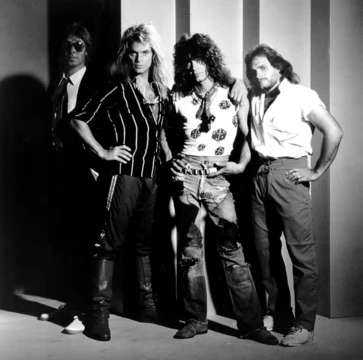
Runnin' with the Devil
Three chords, one blazing riff, and a guitar that rewrote the rules of rock forever.

"Runnin' with the Devil" is the thundering opening track on Van Halen's self-titled 1978 debut album, and it remains one of the most iconic hard-rock songs ever recorded. Written by Eddie Van Halen, Alex Van Halen, and Michael Anthony, the song detonates onto the listener with a ferocious, syncopated riff that immediately established the band's signature sound: a marriage of bluesy swagger, technical virtuosity, and unapologetic energy. Beyond its raw power, the track holds a landmark place in guitar history. It was among the first mainstream rock recordings to prominently feature Eddie Van Halen's revolutionary two-handed tapping technique on the lead guitar, a method that would go on to reshape how the instrument was played and taught for decades. For fans, it is the sound of a band from Pasadena, California, kicking the door off its hinges and announcing that rock and roll had a new, faster, louder voice—one that still echoes through every dive bar and stadium where a kid cranks a Marshall amp to 11.
- Song title
- Runnin' with the Devil
- Artist
- Van Halen
- Album
- Van Halen (self-titled debut, 1978)
- Track position
- Opening track (Track 1)
- Writers
- Eddie Van Halen, Alex Van Halen, Michael Anthony
- Genre
- Hard rock / Heavy metal
- Notable technique
- Two-handed tapping (pioneering mainstream use)
Lore & Background
When Van Halen walked into the studio to record their debut, they carried with them a sound forged in years of garage rehearsals in Pasadena—the air thick with sweat, cigarette smoke, and the hum of amps pushed past their limits. "Runnin' with the Devil" was chosen as the album's opener because it encapsulated everything the band wanted to say: speed, attitude, and a refusal to slow down. The song's lyrics paint a vivid picture of a couple living on the edge, outrunning consequences and chasing the thrill of the open road. It is less a narrative and more a feeling—a burst of adrenaline set to a driving four-on-the-floor rhythm. Musically, the track is a masterclass in economy and impact. The main riff is deceptively simple in its construction yet devastating in its execution, built on a palm-muted, staccato pulse that locks in with Alex Van Halen's tight, aggressive drumming. Michael Anthony's bass lines cut through the mix with a growl that anchors the low end while leaving space for Eddie's lead work to explode. The chorus lifts the energy into a singalong anthem that still packs arenas half a century later. The most celebrated element, however, is the guitar solo. Eddie's use of alternate picking combined with his nascent tapping approach produced a cascading, almost liquid run of notes that sounded impossibly fast and impossibly clean. Listeners and fellow musicians who heard it for the first time often described a sense of disbelief—how could one person play those notes with two hands? That moment of surprise is what gave the song its mythic status and launched a wave of young guitarists into the tapping era, each one trying to decode the magic that began in a single garage.
In Their Own Story
The garage smelled of solder, stale coffee, and the warm ozone of a tube amp pushed past its comfort zone. Eddie sat cross-legged on the concrete floor, his Stratocaster-shaped guitar strapped tight, fingers dancing across the fretboard in a pattern no one in the room had ever seen. Alex, behind a battered drum kit, kept a relentless backbeat, eyes half-closed, counting in his head. Michael leaned against the wall, bass slung low, grinning as the riff built and built. Eddie hit the final note, let it ring, and looked up. "That's the one," he said. "That's the song that opens the album." Outside, a car rumbled past, its headlights briefly cutting through the grimy window, but inside, the three of them knew they had just captured lightning in a concrete box.
Reader's Guide
"Runnin' with the Devil" is the first thing you hear when you drop the needle on Van Halen's 1978 self-titled debut, and it sets the tone for everything that follows. Think of it as the band's handshake: fast, confident, and slightly dangerous. The song is built on a relentless, syncopated riff that drives the entire track forward. There is no slow build, no gentle introduction. You are hit with the groove immediately, and it never lets up. The rhythm section—Alex on drums, Michael on bass—locks into a tight, interlocking pulse that gives the song its galloping, can't-stop momentum. The vocal melody is straightforward and anthemic, designed to be shouted along to. The lyrics evoke a sense of reckless freedom, a couple on the run, living fast and not looking back. It is pure, unfiltered rock-and-roll energy without pretense. The guitar work is where the song becomes legendary. Eddie Van Halen's lead parts showcase his two-handed tapping technique in a way that was virtually unheard of in mainstream rock at the time. The notes flow in rapid, cascading bursts that seem to defy the physical limits of the instrument. It is not just a solo; it is a statement that the guitar could be something entirely new. For new fans, this is the song to start with. It is the sound of a band that had nothing to prove and everything to say, and it still hits like the first time you heard it.
Did You Know?
- The song was one of the first mainstream rock recordings to feature Eddie Van Halen's two-handed tapping technique, a method that would influence generations of guitarists—and make thousands of bedroom players curse thei
- It serves as the opening track on Van Halen's self-titled 1978 debut album, meaning it is the very first sound a listener encounters when experiencing the band's recorded legacy—a sonic slap that says, 'Buckle up, becaus
- The track was co-written by all three core members—Eddie Van Halen, Alex Van Halen, and Michael Anthony—reflecting the collaborative spirit that defined the band's early creative process, a rare moment of democracy befor
- The song's main riff is built on a palm-muted, staccato pattern that became one of the most recognizable and imitated guitar grooves in hard-rock history, inspiring a million garage bands to try and capture that same gre
More in Lore & History
Elsewhere in the Van Halen universe
Spotted an error? Know more?
This is a living reference — every entry is fact-audited, and reader corrections feed straight into our audit queue. Suggest an edit · See this site's audit record