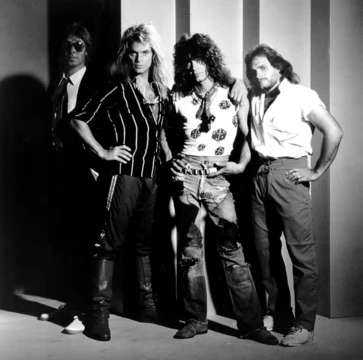
Hagar Era
The Red Rocker who steered Van Halen to their commercial peak.
The Hagar Era (1985–1996, with a brief revival in the early 2000s) marks Van Halen's transformation from a party-hearty, diamond-dusted circus into a platinum-polished hit machine. After original frontman David Lee Roth split for a solo career, the band needed a new voice—and found one in Sammy Hagar, a raspy-voiced road warrior already famous for screaming 'I Can't Drive 55.' Under Hagar, Van Halen traded some of their swaggering, vaudeville energy for a sleeker, radio-ready sound built on shimmering synths, airtight harmonies, and anthemic choruses that could fill a stadium. The result? Unprecedented commercial success, a new generation of fans, and a schism among diehards that still rages today: Roth or Hagar?
- Role
- Lead vocalist and frontman of Van Halen
- Affiliation
- Van Halen
- First appears
- 1985
- Status
- Former member (two tenures: 1985–1996 and 2003–2005)
Lore & Background
When Sammy Hagar joined Van Halen in 1985, the band was a supernova in freefall. Original singer David Lee Roth had bolted for a solo career, leaving Eddie Van Halen, Alex Van Halen, and Michael Anthony to pick up the pieces. Enter Hagar—a solo star with a raspy, soulful howl and a knack for writing choruses that lodged in your brain like a splinter. The chemistry was immediate: their first album together, '5150' (named after the California police code for a mentally disturbed person, a nod to the band's own chaos), debuted at number one on the Billboard 200. It was a statement: Van Halen could not only survive without Roth, but thrive. Over the next decade, the Hagar lineup cranked out a string of chart-topping albums—'OU812,' 'For Unlawful Carnal Knowledge,' 'Balance'—and radio staples like 'Why Can't This Be Love,' 'Right Now,' and 'Dreams.' These songs revealed a more introspective, melodic side of the band, with Hagar's lyrics often touching on self-reflection and resilience rather than Roth's tales of cheap thrills and fast women. In 1992, the band won a Grammy for Best Hard Rock Performance for the track 'Top of the World.' But backstage, tensions simmered. Eddie's perfectionism and struggles with addiction clashed with Hagar's drive for creative input. The rift widened until 1996, when Hagar learned of his own firing through a press release—a cold end to a hot era. A brief reunion in the early 2000s for a compilation and tour rekindled the magic, but the flame didn't last. Today, fans fiercely debate the two eras, but few deny that the Hagar years were Van Halen at their most commercially dominant, a time when the band traded some of its jagged edges for a smoother, more powerful engine.
In Their Own Story
The arena lights cut to black, then burst back as a single guitar note rings out—Eddie Van Halen, alone on a darkened stage, coaxing a shimmering, synth-like tone from his striped Kramer. The crowd, 20,000 strong, holds its breath. Then a drum fill from Alex, a bass throb from Michael, and Sammy Hagar bounds into the spotlight, red hair wild, grin wide. 'Alright, Vegas!' he roars, and the band detonates into 'Poundcake.' For the next two hours, they are a machine of pure joy: Eddie's fingers a blur, Sammy's voice a raspy engine, the whole arena swaying with hands in the air during 'Dreams.' But later, in the quiet of the dressing room, the air is thick. Eddie sits hunched over a guitar, not looking up. Sammy cracks a beer, but the joke he starts dies in his throat. The music said everything words couldn't—and now the silence says the rest.
Reader's Guide
Sammy Hagar, known as the Red Rocker, joined Van Halen in 1985 and became the voice of their most commercially successful era. His role was to replace the charismatic David Lee Roth, bringing a new vocal style and songwriting approach that emphasized melody and accessibility. Hagar's arc included leading the band through five studio albums, achieving multiple number-one hits, and winning a Grammy. His skills included a powerful, raspy singing voice and a talent for crafting anthemic choruses. Defining moments include the release of '5150,' which silenced critics, and the Grammy win for 'For Unlawful Carnal Knowledge.' Hagar's tenure ended in 1996 due to creative differences, but his impact on Van Halen's legacy is undeniable, marking a period of evolution and mainstream dominance.
Did You Know?
- Sammy Hagar was the first non-family member to co-write songs with Eddie Van Halen, leading to a more collaborative songwriting process.
- The album '5150' was named after a California police code for a mentally disturbed person—a joke about the band's chaotic energy.
- Hagar's departure in 1996 was so abrupt that he learned about it through a press release from the band.
- During the Hagar Era, Van Halen became the first band to have three consecutive studio albums debut at number one on the Billboard 200.
- Hagar's first show with Van Halen was in front of 10,000 fans in Shreveport, Louisiana, where he sang 'I Can't Drive 55' as an encore—a song he'd written years earlier as a solo artist.
More in Characters
Elsewhere in the Van Halen universe
Spotted an error? Know more?
This is a living reference — every entry is fact-audited, and reader corrections feed straight into our audit queue. Suggest an edit · See this site's audit record