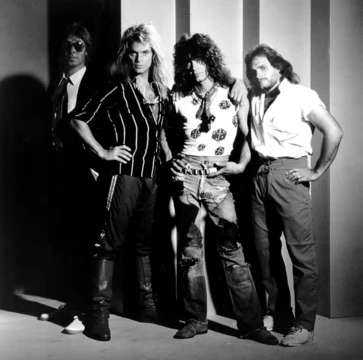
Roth Era
The era when rock was a party, and Van Halen threw the wildest one.
The Roth Era was Van Halen's founding, defining, and most decadent period, when David Lee Roth—part ringmaster, part kung-fu kicker—fronted the band. Spanning 1978 to 1985, this era fused Eddie Van Halen's revolutionary, two-handed guitar tapping with Roth's swaggering, unpredictable showmanship, birthing a sound that was both technically jaw-dropping and irresistibly fun. For legions of fans, it remains the band's untouchable peak.
- Role
- Lead vocalist and frontman
- Affiliation
- Van Halen (original lineup)
- First appears
- Van Halen's debut album (1978)
- Status
- Active during the era; Roth departed in 1985
Lore & Background
The Roth Era is the story of four guys from Pasadena who turned every arena into a bacchanal. David Lee Roth didn't just sing—he karate-chopped the air, split his legs mid-jump, and traded wisecracks with a crowd that worshipped him. Eddie's fingers flew across the fretboard like they were on fire, while Alex Van Halen's thunderous drums and Michael Anthony's high-harmony vocals locked it all into a groove that was part boogie, part assault. Together, they churned out platinum albums—Van Halen, Van Halen II, Women and Children First, Fair Warning, Diver Down, and 1984—each one a snapshot of a band drunk on its own chemistry. Hits like 'Runnin' with the Devil,' 'Panama,' and 'Jump' became anthems for anyone who wanted to feel invincible. Visually, the era was a riot: Roth's leopard-print scarves, Eddie's Frankenstrat guitar with its red-and-white stripes, and a stage that felt like the world's most exclusive house party. But the magic came with friction. Roth and Eddie's creative tension—part brotherly rivalry, part ego clash—fueled the music until it finally broke them apart. Roth left in 1985, and the party ended. But for those who were there—or wish they were—this era is Van Halen.
In Their Own Story
The arena lights cut to black. A single spot finds David Lee Roth, strutting from the wings in a silk shirt unbuttoned to his navel, a microphone stand twirling in his hand like a baton. He grins—a flash of pure mischief—and the crowd roars before he even speaks. Behind him, Eddie Van Halen taps the neck of his striped guitar, and a cascade of harmonics rains down, each note a little miracle of physics. Roth kicks a leg higher than any rock star has a right to, and the first chord of 'Unchained' detonates. For the next two hours, the band rides a wave of sweat, smoke, and pure velocity. Roth leaps off a monitor, lands in a split, and never misses a lyric. Eddie closes his eyes and coaxes sounds from his guitar that sound like laughter, then fury. By the final chord of 'Ain't Talkin' 'Bout Love,' the crowd is hoarse, the stage is littered with setlists and water bottles, and Roth takes a bow like a matador who just won his last bullfight. The night feels infinite—and for a moment, it is.
Reader's Guide
David Lee Roth was the flamboyant, acrobatic frontman of Van Halen during their classic Roth Era—a whirlwind of charisma, martial arts kicks, and razor-sharp wit. His job was to own the spotlight, turning every concert into a spectacle of excess and joy. Vocally, Roth could snarl like a street fighter on 'Runnin' with the Devil' or soar into a sweet falsetto on 'Dance the Night Away.' But his real superpower was showmanship: he'd leap onto drum risers, spin microphone stands like batons, and banter with the crowd as if they were old friends. His arc began with the band's 1978 debut, where his leopard-print outfits and party-boy persona instantly defined Van Halen's image. It peaked with 1984, an album that saw him co-write the synth-driven anthem 'Jump'—the band's only number-one single—and star in a video that made his high-kicks iconic. But creative clashes with Eddie Van Halen, especially over musical direction, led to his departure in 1985. Roth's legacy is that of a rock god who never took himself too seriously, a frontman who made every show feel like the best night of your life—and a fan favorite whose shadow looms over every Van Halen era that followed.
Did You Know?
- David Lee Roth's signature stage jump—a full split in midair—was so athletic that he once pulled a hamstring live and finished the show hopping on one foot.
- The Roth Era produced Van Halen's only number-one single, 'Jump,' in 1984—a song Roth pushed for despite Eddie's initial reluctance to write a synth-heavy track.
- Roth's flamboyant style was inspired by classic showmen like James Brown and Mick Jagger, but he added his own twist: kung-fu moves from his martial arts training.
- He left Van Halen in 1985 to pursue a solo career, famously saying, 'I've got a lot of great ideas, and I can't wait to get them down on paper.' The band went on hiatus, replacing him with Sammy Hagar.
More in Characters
Elsewhere in the Van Halen universe
Spotted an error? Know more?
This is a living reference — every entry is fact-audited, and reader corrections feed straight into our audit queue. Suggest an edit · See this site's audit record